
Here’s the practical version: a wet yard is almost always a water-path problem, not a “need more pipe” problem. In Bergen County — tight suburban lots, mid-century grading that has settled, leaf-heavy trees in places like Mahwah, Ridgewood, and parts of Paramus — water shows up as ponding, mushy lawns, and sometimes a wet foundation line. Fix the path and the outlet. Skip that, and a trench full of pipe just becomes a long, expensive puddle.
This is a coach-style checklist: what to observe, what to try first, which system fits which problem, and how to avoid the classic DIY failures. It supports the service overview at yard drainage.
For foundation seepage and interior systems, see also basement waterproofing and French drains — yard drainage is the outdoor half of the story.
Why Bergen lots get soggy in the first place
A lot of the county’s suburban yards were graded once in the 1950s–1970s and never truly re-set. Soil settles. Patios and walks get added. Neighbors raise beds. Downspouts that once cleared the foundation now dump into a mulch ring. In wooded pockets — Mahwah, Ridgewood, parts of Paramus — fall leaf load clogs gutters fast and turns every heavy rain into a roof-water event at the foundation line. Low-lying and Meadowlands-adjacent areas (portions of Little Ferry, Carlstadt, Lyndhurst, and similar) may add shallow drainage constraints; still verify your lot rather than assuming a town-wide water table story.
None of that means you automatically need a full-yard pipe network. It means you start with observation, not equipment.
Step 1 — Watch where the water goes (after real rain)
Grab a notepad after a storm. Walk the lot. Answer:
- Is it roof water? Gutters overflowing? Downspouts dumping at the foundation or into a bed that never dries?
- Is it surface runoff? Water sheet-flowing from a neighbor, driveway, or reverse grade toward the house?
- Is it a low spot? One bowl in the lawn that holds water for days?
- Is it subsurface? Ground stays saturated even when the surface looks “fixed”?
- Where is a legal outlet? Daylight lower on the lot, dry well, approved storm path — not the neighbor’s yard or the sidewalk.
No diagnosis, no trench. “It rained hard once” is not a full-system order form.
Step 2 — Do the cheap moves first
Before anyone digs deep:
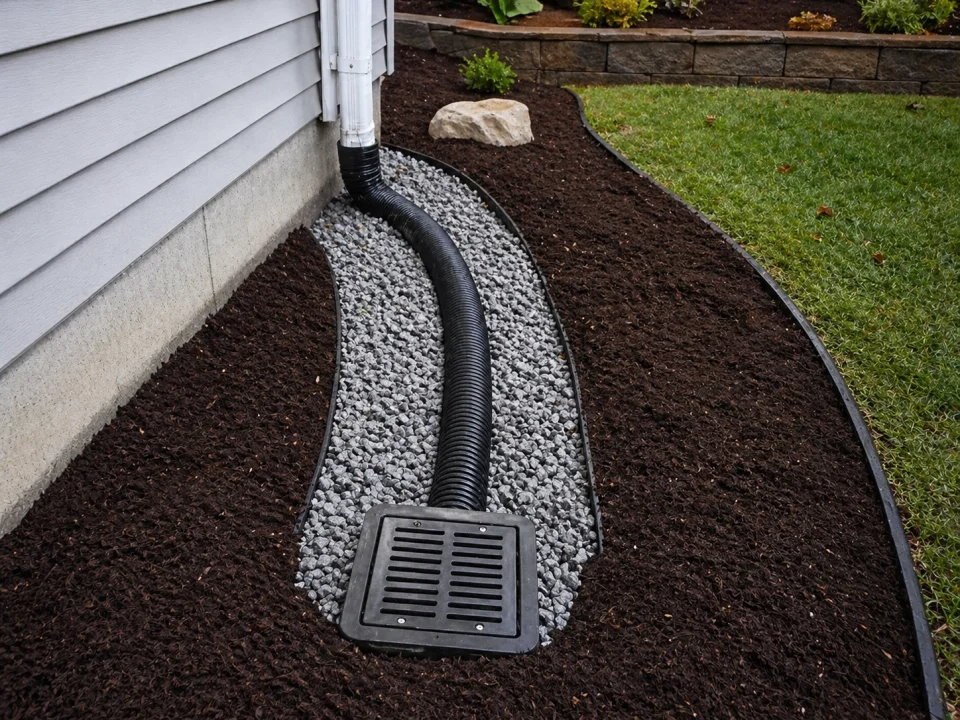
- Clean gutters — especially under heavy canopy
- Extend downspouts well away from the foundation (splash blocks alone often fail on settled lots)
- Re-establish positive grade away from the house where the soil allows
- Check that hardscape (patios, walks) is not pitching water toward the wall
A real share of soggy Bergen yards improve when roof water stops loading the low corner. If a contractor never looks at downspouts, keep shopping.
Step 3 — Match the tool to the problem
Regrade / swale
When surface water is the whole story. Shapes the ground so water moves to a safe low point. Often pairs with downspout work.
Surface drains and catch basins
When you can point to a ponding spot. Grates collect surface water and pipe it away. Good for drive edges, low patio corners, and yard bowls.
Channel / trench drains
When water runs along a hard edge (driveway apron, patio seam) and needs a linear pickup.
Yard interceptor (French) drain
When water is moving under the surface across the lot after grading fixes fail. Perforated pipe in clean stone, wrapped in fabric, continuous drainage to a real outlet. Not the same job as an interior perimeter basement system — different problem, different dig.
Solid buried downspout lines
When leaders flood beds or the foundation line; convey roof water to a remote approved outlet (pop-up, dry well, daylight).
Pump-assisted discharge
Only when gravity will not reach a legal outlet. Last resort after gravity paths are ruled out — pumps need maintenance and power.
Combinations are normal: regrade + catch basin, or downspout lines + yard drain. Honest scopes say that.
Build details that decide whether it lasts
Continuous drainage to a real outlet
The line needs continuous positive drainage toward an approved outlet or dry well. Exact slope is site-specific — elevations, pipe layout, and whether the run is gravity or pumped matter more than a universal “must be X%” slogan. Flat sections hold water. Dead-ends at the fence line create new problems.
Fabric + clean stone
Non-woven geotextile and washed stone (no fines) keep silt and roots from packing the trench. Pipe in dirt without fabric is how a system silts in a season.
Legal outlet
Do not dump onto a neighbor’s property or a public walk. Daylight lower on the lot,
sized dry well, or approved storm connection — plan that before the trench.
Stormwater and groundwater systems generally should not discharge into sanitary
sewers unless expressly permitted by the sewer authority or local rules.
Utility locate
Call 811 before any dig. Tight Bergen lots hide gas, electric, water, cable, and irrigation. Deep trenches without locate are how projects become emergencies.
What it costs (ranges, always site-specific)
Broad trade patterns (~2026):
- Downspout extensions / simple regrade: a typical package sits around hundreds to low thousands
- Multi-line yard drain + catch basins with turf/hardscape restore: commonly mid thousands and up
What moves the number: length and depth, rock and roots, number of basins, dry well vs. daylight, hardscape restore, and access on tight lots. Typical sections often run on the order of 1–3 days; rock, trees, or full-yard networks take longer.
Permits — confirm your town
Simple on-lot regrade and downspout work is often permit-light — confirm Authority Having Jurisdiction (AHJ — your local building department). Major grading, connecting to municipal storm systems, work near regulated areas, or other scoped excavation can need municipal review. Requirements vary by municipality. Do not invent setbacks or storm-connection rules. We verify before construction when the scope triggers review.
DIY stop-line (be honest with yourself)
Reasonable DIY: hand grading, splash blocks, short above-grade extensions, watching water after storms.
Pro territory: deep trenches, dry wells, utility-dense digs, laser-set long runs, anything near the foundation that could recirculate water into the basement.
If you are already fighting foundation seepage, coordinate yard work with a foundation diagnosis — outdoor fixes and interior systems are one water story, not two unrelated quotes.
Red flags
- “More pipe always fixes it” with no outlet plan
- Discharge aimed at the property line
- Corrugated pipe in dirt, no fabric or clean stone
- No 811 / utility conversation
- A full system sold after one hard rain with no grade or downspout check
Action checklist you can use this week
- After the next rain, mark ponding spots with flags or photos
- Trace every downspout to where water actually stops
- Note neighbor runoff and driveway pitch
- List one legal outlet idea (lower daylight, dry well location, etc.)
- Call for a site walk if grade and extensions will not reach the problem
Optional sixth step: take a short video walking from the wettest spot to the lowest legal place water could go. That clip is more useful in a contractor conversation than any product brochure.
When yard work meets the foundation
If the basement is wet and the yard ponds, treat them as one diagnosis with two possible toolkits — outdoor collection/conveyance and foundation-side systems. Fixing only the lawn while cold-joint seepage continues (or only the interior drain while downspouts still dump at the wall) is how people buy twice. Coordinate scopes when both symptoms show up after the same storm.