
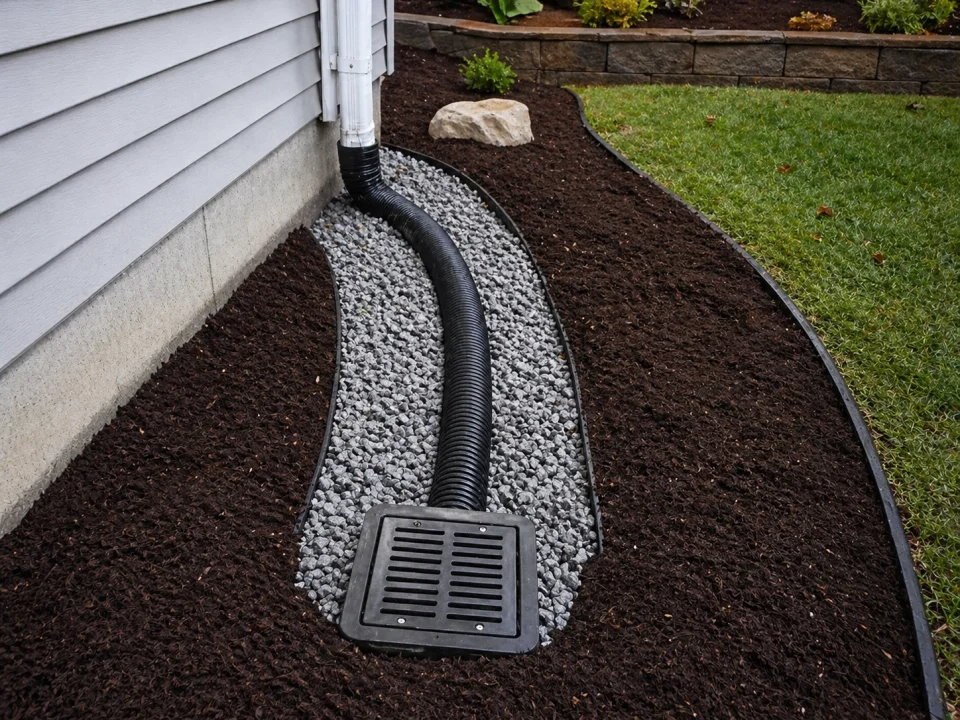
Yard Drainage & Downspout Systems
Standing water has a source and a path — grading, downspouts, catch basins, and dry wells that move it away from the house for good.
Yard Drainage Design & Installation
Standing water, eroding lawn edges, and wet basements after rain events are symptoms of the same underlying problem: water with nowhere to go. Bergen Restoration assesses your property’s drainage flow paths, identifies where surface and subsurface water is accumulating, and designs a system to move it away — from the house, from the lawn, and from the foundation. We coordinate with French drain and foundation crack repair work where drainage and structural water pressure are connected.
- Surface re-grading and slope correction away from the foundation
- Catch basin installation at low points and driveway aprons
- Underground downspout discharge routing away from the house
- Channel drains and trench drains for paved areas and patios
- Dry wells and infiltration chambers for on-site absorption
- Downspout extension and disconnection from foundation discharge
- French drain coordination for subsurface water relief
- Foundation crack coordination where drainage is the root cause of seepage
Foundation and drainage work should solve the source before damaged interiors are rebuilt. Bergen Restoration can coordinate the water-control work with broader home restoration when repairs extend inside the house.
Serving homeowners throughout all 70 Bergen County municipalities. View our Bergen County service areas.
Yard Drainage Guides
Grading, drain, and discharge calls that move water away from the house.
Site Survey & Grading
- Lot survey, elevation shots, soil drainage assessment, and identification of water paths and low points before scope locks.
- Grade solutions come before pipe solutions — many wet basements are fixed by regrading and downspout work alone.
- Neighbor lots, street drainage, and roof water volume are mapped so the plan does not push water onto someone else’s property.
- A laser or level survey maps the actual fall across the lot — drainage designs on eyeball grading fail on the first real storm.
- The soil's percolation and the water's destination get established before any trench is drawn.
Planning a project like this? Get an estimate.
Surface Drains & Catch Basins
- Catch basins and channel drains sit at real low points — driveway aprons, patio edges, and yard bowls — not where they look neat on a plan.
- Grate size and pipe diameter follow expected flow from roof and hardscape, not the smallest box that fits the trench.
- Discharge ends far enough from the foundation that collected water does not re-enter the basement perimeter.
- Catch basins collect where water already pools; grates and sumps size to the watershed feeding them.
- Channel drains handle hardscape sheets — driveway and patio runoff intercepted before it reaches the foundation line.
Planning a project like this? Get an estimate.
Subsurface French Drains
- Perforated pipe in washed stone collects subsurface water before it loads the foundation wall.
- Trench depth and fabric wrap keep fines out of the stone so the drain does not silt shut in a few seasons.
- Daylight, dry well, or sump termination is chosen from grade and town rules — a French drain without an exit is a linear swamp.
- Consistent pipe fall is the invisible spec — a bellied run collects sediment and quits within seasons.
- Trench depth follows the target water: surface sogginess drains shallow; foundation-line interception digs toward footing.
Planning a project like this? Get an estimate.
Downspout Extensions & Burial
- Discharge points routed safely away from foundation per town stormwater code (daylight, dry well, recharge bed, or storm sewer where permitted).
- Catch basins, channel drains, and downspout extensions sized to expected flow rates.
- Buried downspout lines move roof water — often half the yard's problem — to daylight in one unglamorous fix.
- Cleanouts at direction changes keep buried lines serviceable; buried and forgotten becomes buried and clogged.
- Solid pipe (not perforated) carries roof water through the yard — mixing pipe types re-soaks the lawn mid-route.
Planning a project like this? Get an estimate.
Discharge & Daylight Termination
- Discharge points routed safely away from foundation per town stormwater code (daylight, dry well, recharge bed, or storm sewer where permitted).
- Surface drains and catch basins sized to the water they actually collect.
- Every system needs somewhere legal and lower to send water — daylight, drywell, or street per municipal rules.
- Discharge onto a neighbor is a dispute waiting on a storm; the termination plan respects the property line and the borough code.
- Drywells size to storm volume and soil percolation — an undersized drywell is a buried bucket.
Planning a project like this? Get an estimate.
Cost & Timeline Guide
- Surface drains and regrading can be modest; French drains and sump tie-ins scale with trench length and discharge path.
- Utilities in the dig path, hardscape restoration, and haul-off of spoils are the classic overruns.
- Stormwater rules vary by town; schedule follows weather and excavation access more than pipe price.
- Scope follows linear footage, depth, and destination — surveyed and quoted from the actual grades, not the catalog.
- Most residential systems install in 2–5 days; lawns heal over a season, and the basement notices the first storm.
Planning a project like this? Get an estimate.
Your Yard Drainage Process
Site assessment
Walk the property to identify pooling zones, drainage flow paths, and downspout discharge points. Evaluate grading slope away from the foundation and note any connected basement or crack issues.
Design & plan
Select the combination of surface, subsurface, and downspout routing solutions suited to the property. We explain the options and expected outcomes before anything is scheduled.
Install
Excavate trenches, install drainage components (catch basins, pipe runs, dry wells, channel drains), backfill, and restore the surface. Downspout connections rerouted underground where applicable.
Verify & coordinate
Confirm drainage paths run clear and discharge at a safe distance from the foundation. Coordinate French drain or foundation crack repair work where water pressure is a compounding factor.
Frequently Asked Questions
Pooling is usually caused by flat or low-lying areas where water has nowhere to go, soil that has become compacted over time, downspouts discharging too close to the house, or inadequate slope away from the foundation. A drainage assessment identifies which factor applies and what combination of surface or subsurface solutions will move water effectively.
A catch basin is a ground-level inlet box connected to an underground pipe that routes collected water away from the yard — typically to the street, a dry well, or a discharge point at the property edge. They are placed at low points where water naturally concentrates, preventing standing water in lawns, driveways, and near foundations.
Yes. Downspouts can be connected to underground pipes that carry roof runoff away from the foundation and discharge it at a safe distance. This is one of the most cost-effective ways to reduce water pressure near basement walls and foundation cracks.
Downspouts and yard runoff that discharge too close to the house are a common cause of foundation crack leaks and basement seepage. Correcting yard drainage reduces the water pressure that causes cracks to worsen over time. We coordinate yard drainage work with foundation crack repair and French drain installation where multiple issues are present.
Yes. Bergen Restoration is a registered New Jersey Home Improvement Contractor (NJHIC# 13VH08865500) with commercial general liability and workers’ compensation coverage; documentation available on request.
The water picks: sheeting surface water wants grading and basins; saturated ground wants subsurface collection; roof water wants downspout routing first. We watch where it goes after real rain and match the tool.
Daylight at a lower grade, a dry well sized to the flow, or storm infrastructure where the town allows — discharge rules vary by municipality and we route accordingly.
Trenches get cut clean, soil staged on tarps, and turf restored — a few weeks of scar lines, then gone. Sod patches speed the cosmetic recovery where it matters.
A buried, gravel-wrapped chamber that accepts a surge and soaks it away — great in draining soils, useless in saturated clay. A perc check before design tells us which yard you own.
We manage water inside your line — swales and interceptor drains that catch cross-lot flow before it reaches beds or foundation. Grading wars get solved with engineering, not fences.
Buried lines below frost behave; surface pop-ups and shallow runs need freeze-conscious detailing. A system that works in July and fails in February was designed for July.
Grade that falls away from the house, downspouts that actually leave the foundation, then a catch basin or a French drain if the yard still ponds. The cheap first pass is gutters and grade. Pipe in the lawn is for water that still stands after that.
To a place that already takes storm water: daylight on your lot, a dry well sized for the soil, or the town’s storm system if they allow the tie-in. Not onto a neighbor. Not into the sanitary sewer.
Find where the water sits after rain, then raise grade, extend downspouts, or add a catch basin and pipe to a legal outlet. See also https://bergenrestoration.com/services/french-drain/
Part of our Water & Drainage family. See also French Drain Installation, Foundation Crack Repair, and Basement Waterproofing.
Get Your Estimate
Tell us about your yard drainage or downspout concern. We’ll follow up with the next best step.
Commercial general liability and workers’ compensation coverage. Documentation available on request.
Let’s Talk About Your Project
Tell us what you have in mind — we’ll follow up with a plan.