
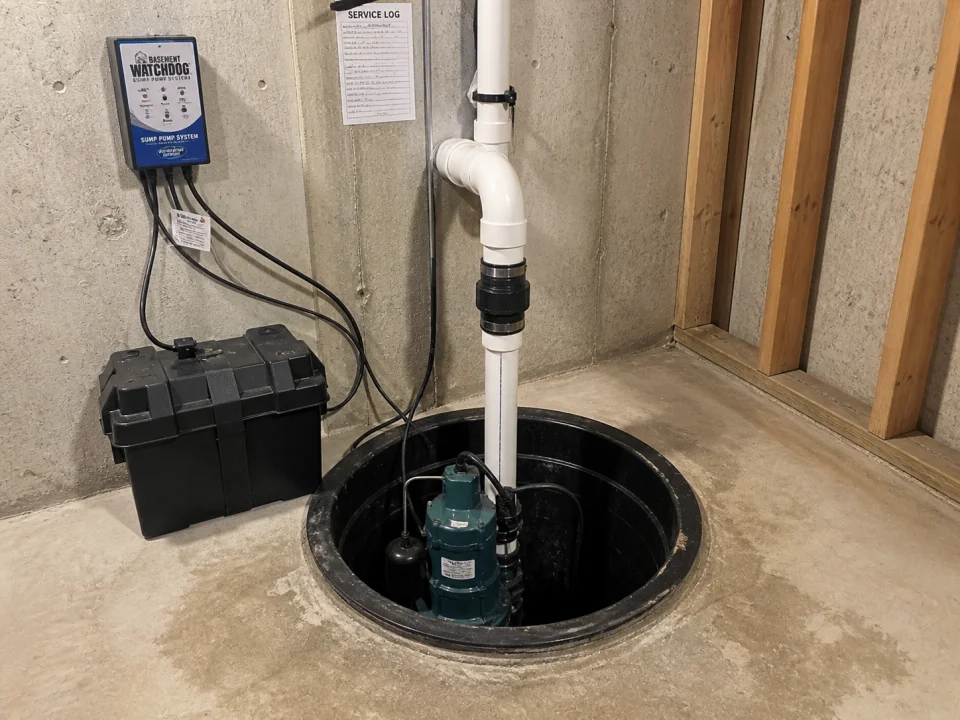
Sump Pump Installation
Sump pump installation for Bergen County basements. New pit excavation, submersible and pedestal pump systems, battery backup, and proper discharge routing — by a registered NJ contractor.
Sump Pump & Drainage Systems
We install submersible and pedestal sump pump systems in Bergen County basements. New installations include pit excavation, gravel bed, and proper discharge line routing to daylight or storm drain. We also install battery backup systems and replace aging pumps that are failing or undersized.
- New sump pit excavation and gravel bed
- Submersible and pedestal pump installation
- Battery backup system installation
- Discharge line routing to daylight or storm drain
- Check valve and backflow protection
- Existing pump replacement and upgrades
- Combination primary + backup systems
- Integration with interior French drain systems
Pricing and timelines are planning ranges. Final cost and schedule depend on site conditions, access, structural requirements, materials, permit review, inspections, weather, material lead times, and scheduling availability.
Serving homeowners throughout all 70 Bergen County municipalities. View our Bergen County service areas.
Sump Pump & Backup Guides
Pump sizing, backup, and discharge calls that keep a basement dry in a storm.
Pump Sizing & Capacity
- GPM is matched to drain-tile inflow and vertical head to the discharge — not a catalog horsepower pick.
- Basin volume and float settings control cycle length; an undersized basin short-cycles a correctly sized pump to death.
- When inflow is unknown, we size from the worst documented rain event and leave headroom rather than guessing low.
- Pump capacity is matched to observed inflow with headroom for storm surge — an undersized pump runs constantly and still loses.
- Cast-iron submersibles with vertical floats are the durability spec for pits that cycle often.
Planning a project like this? Get an estimate.
Battery Backup Systems
- The backup pump earns its keep the night a nor’easter takes the power out at high water — the exact night the primary is busiest.
- Battery capacity is sized to expected runtime, and a maintainer keeps the battery honest between storms.
- Water-powered backups are the no-battery alternative where municipal pressure allows — unlimited runtime, no charge state to check.
- Runtime math sizes the battery to your storm profile, not the box label — outage length times cycle rate is the real spec.
- Maintainers keep standby batteries charged and honest between storms; a dead backup discovered mid-outage is the classic failure.
Planning a project like this? Get an estimate.
Discharge Line Routing
- Discharge is piped away from the foundation to daylight, a dry well, or a permitted storm connection — never recycled into the same soils that feed the tile.
- Slope, pipe size, and freeze protection (T-fitting or freeze-guard) keep winter ice from backing water into the basin.
- Check valves and cleanouts go where they can be serviced; a buried, inaccessible check valve is a future flood.
- Discharge exits above grade, away from the foundation, and never into the sewer — routing decides whether the pump solves or recirculates.
- Freeze-resistant terminations keep January discharge flowing when the line would otherwise cap with ice.
Planning a project like this? Get an estimate.
Sump Pit & Drainage Connection
- Basin diameter and depth are set for pump clearance, float travel, and enough reserve so the pump is not thrashing on every trickle.
- A gravel base and clean drain-tile entry keep sediment out of the impeller; a clogged inlet looks like a failed pump.
- Lids seal for radon and child safety where the home needs it — the pit is not left as an open hole in a finished floor.
- The pit ties into perimeter drainage where it exists — a sump without collection plumbing only dries its own hole.
- A sealed, childproof lid with a gasketed cord port keeps humidity, radon pathways, and curiosity managed.
Planning a project like this? Get an estimate.
Alarms & Monitoring
- A high-water float alarm announces trouble while it is still a basin problem instead of a basement problem.
- Cellular or Wi-Fi monitoring pushes the alert to your phone — the failure you learn about from the beach beats the one you discover at the carpet.
- Smart-home integration puts pump cycles on a dashboard; a pump that suddenly runs hourly is telling you something about the drainage.
- Check-valve health and float travel get verified at every service — the two cheap parts that cause most 'pump failures'.
- A quarterly bucket test (pour till it cycles) is the homeowner habit that catches silent failures before storms do.
Planning a project like this? Get an estimate.
Cost & Timeline Guide
- The ladder is scope, not brand: replace-in-pit, new pit, backup add-on, full package, then drainage retrofit — each step is a different job.
- Discharge routing, check valves, and electrical for pump and alarm are the usual adders beyond the pump carton.
- Electrical permit is common for new circuits; many replace-in-pit jobs finish in a day or two once parts are on site.
- Install scope follows pit condition and discharge routing — straightforward swaps run hours; new pits with drainage tie-ins run days.
- Replacement beats repair past year 7–10 — pumps fail closed, and the failure date is always a storm date.
Planning a project like this? Get an estimate.
Your Sump Pump Installation Process
Assessment
We inspect the basement, evaluate water entry points, and determine pump size and pit location.
Pit excavation
We excavate the sump pit, set the liner, and add a gravel bed for proper water collection.
Pump & discharge
Pump installation, check valve, and discharge line routed to an appropriate exit point.
Testing & walkthrough
We test the system under load and walk you through maintenance and battery backup operation.
Frequently Asked Questions
Planning ranges for 2026 in Bergen County: pump replacement in an existing sound pit typically $850–$1,800 installed; new pit excavation with pump $1,500–$3,500; battery backup add-on $600–$1,200; pump with battery backup and alarms often $2,200–$4,500; pit retrofit with new drainage $4,500–$9,000+. Lead is commonly 1–3 weeks once parts and access are confirmed. Pricing and timelines are planning ranges; final cost depends on discharge routing, electrical, slab access, and site conditions.
If you have hydrostatic pressure or your home is in a lower-lying area of Bergen County, a sump pump is preventive insurance. Many basements that flood once benefit from a system installed before the next event.
Most residential applications use a 1/3 HP submersible pump (2,000–3,000 GPH capacity). Homes with significant water intrusion may need 1/2 HP or combination systems. We size based on your conditions.
A battery backup pump activates automatically when the primary pump loses power — exactly the scenario most needed during heavy rain. We recommend backup systems for all new installations.
Bergen Restoration is a registered New Jersey Home Improvement Contractor (NJHIC# 13VH08865500) with commercial general liability and workers’ compensation coverage; documentation available on request.
The basement's true low point along the water path — found with a level and the stain history, not guessed. A pump in the wrong corner protects the wrong corner.
Battery backups pump strong regardless of municipal pressure; water-powered units run indefinitely where pressure and local rules allow. Storm-outage reality in Bergen County makes some backup non-negotiable either way.
Short-cycling from a bad check valve or float setting, debris in an unlined pit, and discharge lines that freeze or block. The install details around the pump decide its lifespan.
Away from the foundation to daylight, a dry well, or storm drainage where the town permits — never the sanitary sewer without explicit authority approval. We route per your municipality's rules.
Pour-test the float quarterly and before storm season, and exercise the backup per its manual. A pump that hasn't run since install is a rumor, not a system.
It raises the stakes — the pit, discharge, and alarm get planned around finishes, and a water alarm tied to your phone becomes cheap insurance for the room you just invested in.
A working sump with a clear discharge is a known system, not a red flag by itself. A pit with no pump, or a pump that dumps to the sewer, is what buyers and inspectors flag.
No power, a stuck float, a clogged discharge, and a pump that has run its life. We check those before we talk about a new brand.
Part of our Water Damage & Drainage family. See also Basement Waterproofing, French Drain Installation, and Water Damage Restoration.
Get Your Estimate
Tell us about your project. We’ll follow up with the next best step.
Commercial general liability and workers’ compensation coverage. Documentation available on request.
Let’s Talk About Your Project
Tell us what you have in mind — we’ll follow up with a plan.