
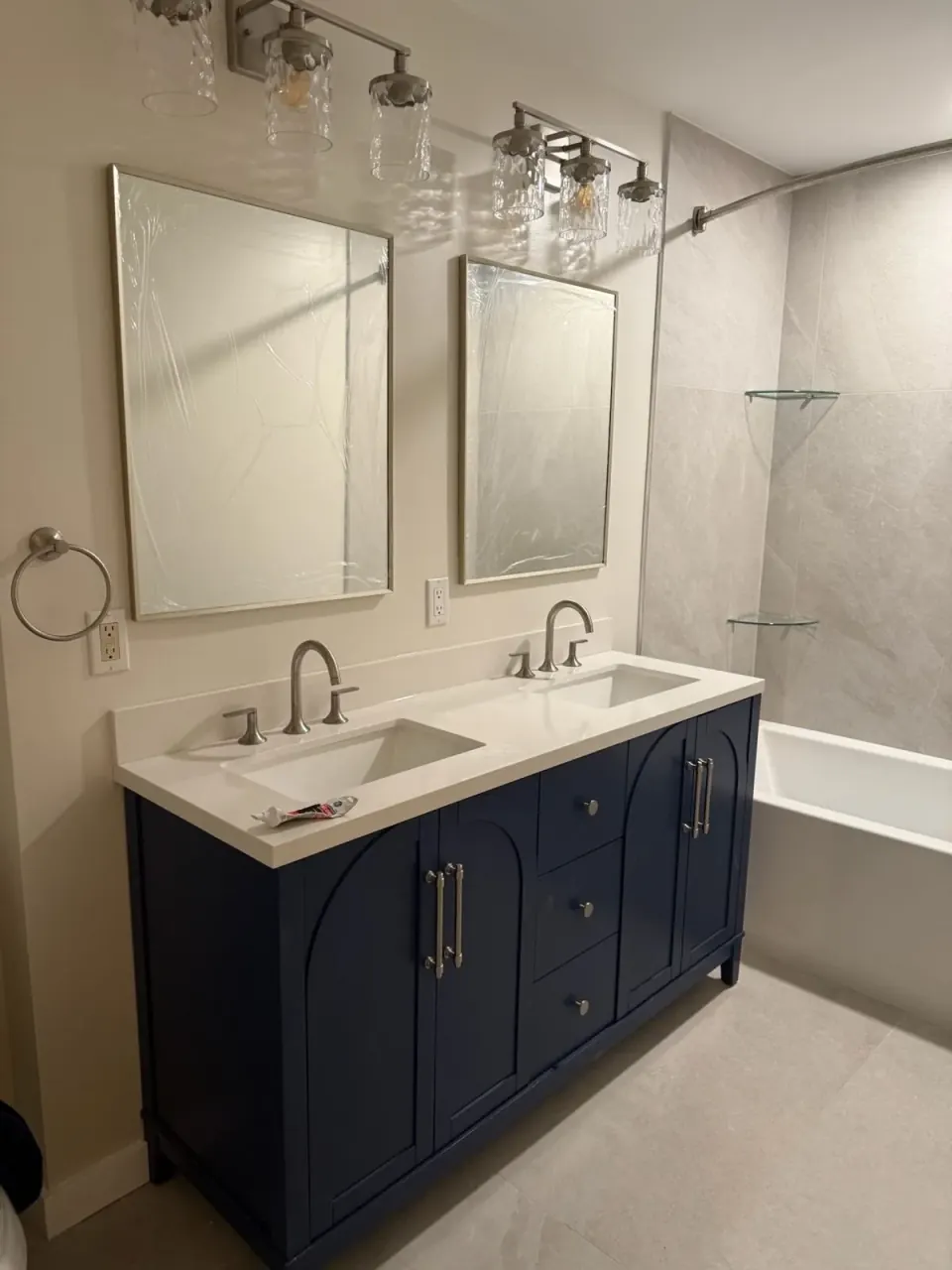
Walk-In Shower Installation
Curbless, low-curb, and walk-in showers with frameless glass, custom tile, recessed niches, linear or center drains, and full Schluter or equivalent waterproofing — built to drain properly and stay leak-free for decades.
Walk-In Showers Built Properly
A walk-in shower is a waterproofing project disguised as a tile project. We use Schluter-Kerdi, Wedi, or equivalent membrane systems, properly sloped pans, linear or center drains sized to the shower, and frameless or low-iron glass. Cheap waterproofing fails in 5-10 years; quality systems outlast the rest of the bathroom.
- Curbless and low-curb walk-in showers
- Frameless glass enclosures and panels
- Linear and center-drain systems with proper slope
- Schluter-Kerdi or equivalent waterproofing
- Custom tile, recessed niches, and bench seats
- Multi-head and rain shower fixture installs
Serving homeowners throughout all 70 Bergen County municipalities. View our Bergen County service areas.
Part of our Bathroom Remodeling service family — explore Safety & Accessibility, Bathroom Addition, Water Damage Rebuild, Full Bathroom Remodel, Guest Suite & In-Law Space, Jack-and-Jill Bathroom, Master Bathroom, Powder Room Remodel, Small Bathroom Remodel, Tub-to-Shower Conversion, and Vanity Replacement.
Walk-In Shower Guides
Waterproofing, drain, and glass choices that keep a walk-in shower leak-free.
Waterproofing System
- Sheet membrane or foam-board systems (Kerdi, Wedi, or equal) form a continuous waterproof envelope — tile is the finish, not the waterproofing.
- Curb construction, pre-slope, and corner seams are detailed before tile; those three decide whether year five is dry or a tear-out.
- Drain flanges integrate into the membrane with the manufacturer’s ring and seals — improvised caulk rings fail first.
- Sheet membranes and liquid-applied systems both work — what matters is one continuous system, correctly lapped, from pan to ceiling.
- Niches, benches, and curbs are waterproofed as part of the envelope, not caulked afterthoughts.
Planning a project like this? Get an estimate.
Drain Type & Placement
- Center drains need four-way slope; linear and trough drains allow single-direction slope and larger-format tile without lippage fights.
- Drain location is set from the door, bench, and glass line so water does not run under the threshold.
- Waste line pitch and trap access are planned at rough-in — moving a drain after the pan is poured is a full rebuild.
- Linear drains free the floor to slope one direction — large-format tile becomes possible where center drains force mosaic.
- Drain placement decides the pan's geometry; it's chosen with the glass plan, not inherited from the old shower.
Planning a project like this? Get an estimate.
Glass Enclosure Options
- Frameless enclosures in 3/8- or 1/2-inch tempered glass carry the premium read; semi-frameless trades a slim frame line for meaningful savings.
- Fixed-panel walk-throughs eliminate the door entirely — fewer moving parts, easier cleaning, and an open feel in wider stalls.
- Hardware finish is matched to the fixture set, and hinges anchor into blocking placed during framing, not into tile alone.
- Low-iron glass drops the green tint and shows feature tile true — the upgrade that matters on showcase walls.
- Hinged doors need dry-swing clearance planned at layout; sliders and fixed panels rescue tight rooms.
Planning a project like this? Get an estimate.
Bench & Niche Planning
- Bench height, depth, and drainage are set in framing so water does not pool on a flat seat.
- Niches are located relative to valves and studs; random cutouts after waterproofing invite leaks.
- Both features are cheap in framing and expensive as retrofits after tile.
- The bench doubles as design and function — floating teak or tiled-in, it's planned with the waterproofing, not added after.
- Niches are sized to real bottles and placed off the show wall — practical storage that doesn't interrupt the feature tile.
Planning a project like this? Get an estimate.
Curbless Conversion
- Recessing the pan means dropping the floor structure between joists, so joist direction and depth get verified before the design is promised.
- A linear drain at the entry or back wall lets the entire floor slope one direction — the geometry that makes curbless work.
- Waterproofing runs continuous from pan up the walls and out across the bathroom floor; curbless failures are almost always membrane shortcuts.
- Slab-on-grade baths take curbless differently — the recess is cut or built up with sloped mortar rather than reframed.
- Water containment in curbless designs comes from slope math and glass placement — engineered, not hoped.
Planning a project like this? Get an estimate.
Cost & Timeline Guide
- Pan, waterproofing, and glass package set most of the number; linear drains and large-format tile add labor.
- Moving the drain, rebuilding a curb-less threshold, and niche work are the mid-job cost jumps.
- Plumbing permit standard; about a week to two on site after waterproofing cure and glass measure.
- Glass is templated after tile and arrives 1–2 weeks later — the schedule's fixed tail that planning absorbs.
- Tile scope and glass spec are the budget's two big levers; the plumbing rarely moves in a shower conversion.
Planning a project like this? Get an estimate.
Your Walk-In Shower Process
Consultation
We measure the bathroom, discuss curbless vs low-curb, identify subfloor and drain conditions, and confirm waterproofing approach.
Scope & materials
We finalize tile, glass, drain type, niche placement, fixture selections, and waterproofing system.
Build
Crew demos existing, builds proper slope, installs membrane, sets tile, hangs glass, installs fixtures.
Final walkthrough
Flood test, final walkthrough, sealant cure period, punch-list closeout.
Frequently Asked Questions
For 2026 in Bergen County, walk-in showers (replacing tub) run $9,000-$22,000 installed. Premium showers with frameless glass, custom tile, multi-head fixtures, and curbless drains run $20,000-$45,000+.
Curbless requires the subfloor to be lowered or the bathroom floor raised for proper drain slope; best during a full bathroom remodel. Low-curb is simpler and works as a tub-to-shower swap. We confirm during the walkthrough.
Standalone walk-in shower install: 2-4 weeks. As part of a larger bathroom remodel: integrated into the project schedule.
Schluter-Kerdi or equivalent fully bonded membrane systems with proper drain integration. We do not rely on tile or grout for waterproofing.
Yes. Bergen Restoration is a registered New Jersey Home Improvement Contractor (NJHIC# 13VH08865500) with commercial general liability and workers' compensation coverage. Documentation is available on request, and homeowners should verify credentials before hiring any contractor.
The pan holds water before tile ever goes on — plugged drain, filled base, wait, verify. It's the cheapest insurance in the whole bathroom and we don't tile without it.
Linear drains enable single-slope floors and large-format tile — the modern look — and suit curbless entries; center drains are the economical classic. Tile choice and entry style drive it.
Both, designed into the tile layout from the start — a bench at the right height and niches where bottles actually live. Retrofitting either after tile is misery.
Frameless panels sized to the opening, hinged where clearance allows, with coatings that shrug water spots. Glass is measured after tile — its lead time is part of the schedule.
Depth and a modest return panel do it — a properly proportioned doorless entry keeps spray and warmth in without a squeegee ritual at the door.
The standard tub alcove converts beautifully — that footprint is exactly our tub-to-shower conversion scope, usually days of work with the layout held.
Leaks at the pan and the niche, a curb that was never waterproofed, glass that was measured before the tile was done, and a fan that dumps humid air into the attic. The real work is doing the pan and the waterproofing membrane right.
Leaving the drain where it is is cheaper than moving it. A conversion that keeps the same footprint has different price tag from a new drain in a new place. See https://bergenrestoration.com/services/tub-to-shower/
The best shower is a waterproof pan and a membrane that matches the drain you already have.
Related reading: Walk-in shower installation: glass, slope & waterproofing.
Get Your Estimate
Reach us by phone or email and tell us about your walk-in shower install project. We will follow up with the next best step for your home.
Commercial general liability and workers’ compensation coverage. Documentation available on request.
Let's Talk About Your Project
Tell us what you have in mind — we'll follow up with a plan.