
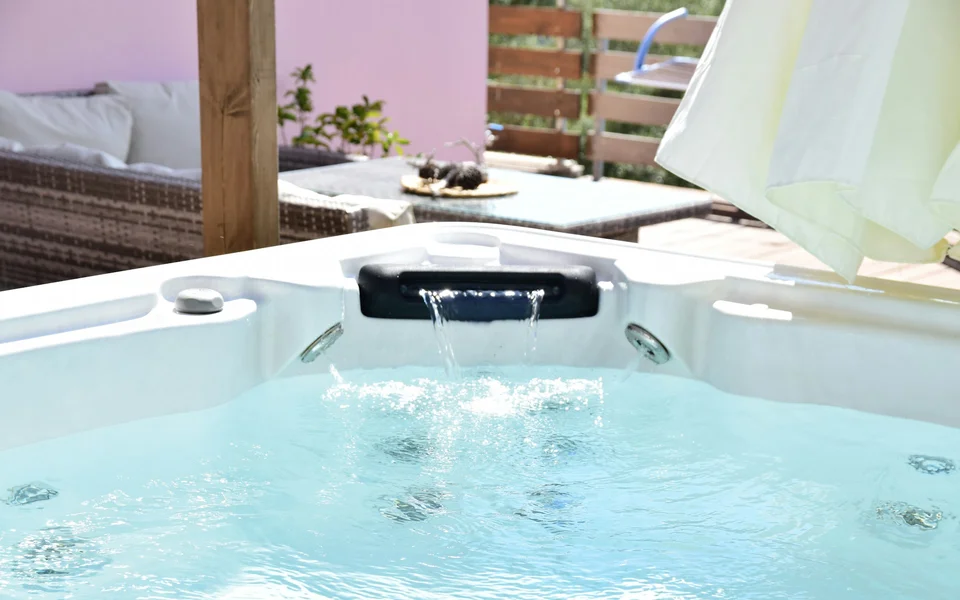
Indoor Hot Tub & Jacuzzi Installation
Indoor hot tub and jacuzzi installation for Bergen County homes. Basement, sunroom, and master bath installations with full waterproofing, ventilation systems, electrical coordination with licensed trades, and plumbing coordination.
Indoor Spa & Hot Tub Build-Out
Indoor hot tub and jacuzzi installations require careful coordination of waterproofing, ventilation, structural support, and mechanical systems. We handle the full build-out — from floor waterproofing and wall moisture barriers to electrical coordination with licensed trades, drainage, and tile surround finish work.
- Basement, sunroom, and addition installations
- Structural floor reinforcement assessment and work
- Waterproof membrane and floor drain installation
- Dedicated exhaust ventilation system (8–10 ACH typical)
- Dehumidification system sized for room and spa output
- 240V/50A GFCI dedicated circuit coordinated with licensed electrical trades
- Plumbing drain and fill connections
- Tile surround, coping, and wet area finish
- Coordination with licensed electricians and plumbers
Pricing and timelines are planning ranges. Final cost and schedule depend on site conditions, access, structural requirements, materials, permit review, inspections, weather, material lead times, and scheduling availability.
Serving homeowners throughout all 70 Bergen County municipalities. View our Bergen County service areas.
Indoor Hot Tub & Jacuzzi Guides
Floor reinforcement, waterproofing, and humidity calls before an indoor tub goes in.
Floor Structural Reinforcement
- A filled spa concentrates 4,000–7,000 pounds on a small footprint — framed floors get engineered reinforcement before the tub is even ordered.
- Slab-on-grade basements carry the load natively, which is why so many indoor spas live downstairs.
- Point-load paths matter: reinforcement lands under the tub’s actual feet, not just somewhere in the room.
- An engineer's letter on framed floors is cheap certainty under four thousand pounds of water.
- Delivery route indoors (doors, stairs, turns) gets templated before purchase — spas don't fold.
Planning a project like this? Get an estimate.
Waterproof Room Construction
- Floor and lower walls get a continuous membrane under tile; splash volume is treated like a wet room, not a dry living space.
- A floor drain or trench catch handles overflow and cleaning water so it never seeks the doorway or adjacent rooms.
- Dedicated exhaust and makeup air keep humidity from migrating into framing and closets on the other side of the wall.
- Wall materials in the splash zone are wet-room grade — cement board and waterproof membrane, not moisture-resistant drywall.
- The room's threshold contains a full-spa accident — containment design assumes the worst day.
Planning a project like this? Get an estimate.
Ventilation & Humidity
- A spa room needs exhaust sized to its volume, ducted outside — never into an attic, where the moisture becomes a rot subscription.
- Integrated dehumidification holds the room in the comfortable range between sessions without running the fan around the clock.
- Vapor-rated finishes and a sealed ceiling plane protect the structure from the humidity the equipment does not catch.
- Humidity control protects the whole house, not just the spa room — vapor migrates to cold corners elsewhere.
- Operable windows help but don't substitute for mechanical exhaust sized to the water surface.
Planning a project like this? Get an estimate.
Licensed Electrical Coordination
- Most indoor spas need a 240V GFCI dedicated circuit with a disconnect within sight of the unit.
- Panel capacity and wire size are verified before the spa ships — a failed load calc means a dead unit in a finished room.
- Licensed electricians pull the permit; bonding and GFCI protection are not optional DIY items.
- The equipment disconnect and GFCI protection follow the same code as outdoor installs — indoors changes nothing electrical.
- Circulation pumps run on schedules — night-rate electricity and quiet hours both favor smart control.
Planning a project like this? Get an estimate.
Plumbing & Drain
- Fill, drain/backwash, and overflow paths are planned so water leaves the room without flooding the hallway.
- Floor drains or pump-out routes are sized for the volume you actually dump during cleaning.
- Licensed plumbers coordinate new vents and cleanouts when the wet room is not on an existing wet wall.
- Fill is easy; drain is design — gravity or pump-out routing is planned before the spa arrives.
- An accessible floor drain keeps routine maintenance from becoming a towel festival.
Planning a project like this? Get an estimate.
Cost & Timeline Guide
- Room build plus spa install $25k–$60k; tile wet-room and premium spa $80k–$180k+.
- Floor structure for filled weight, dedicated electrical, waterproofing, and ventilation are non-negotiable line items.
- Electrical and sometimes plumbing permits; 6–12 weeks after spa lead time and room prep.
- The room build (structure, waterproofing, ventilation) typically exceeds the spa's own price — budget the room first.
- Room-ready to soaking runs 3–6 weeks; the spa itself is the fastest part.
Planning a project like this? Get an estimate.
Your Indoor Hot Tub Installation Process
Site assessment
We evaluate the room’s structural, mechanical, and ventilation requirements before any design.
Design & mechanical plan
We coordinate waterproofing scope, electrical routing, ventilation design, and finish selections.
Structural & rough-in
Floor reinforcement, waterproofing, electrical and plumbing rough-in, and ventilation ducting.
Finish & installation
Tile surround, spa placement, mechanical hookup, and final inspection walkthrough.
Frequently Asked Questions
Yes, but it requires careful moisture and ventilation management. Without proper exhaust ventilation and waterproofing, an indoor spa causes significant moisture damage. We design both into every project.
Almost always yes. A filled 6-person spa can weigh 4,000–6,000 lbs. We assess existing floor structure and add reinforcement as needed before installation.
Dedicated exhaust ventilation (typically 8–10 ACH) and a dehumidification system are standard. We size the system for the room and climate.
Electrical, plumbing, and mechanical permits are typically required. We coordinate permit filings with your town and licensed trades.
Bergen Restoration is a registered New Jersey Home Improvement Contractor (NJHIC# 13VH08865500) with commercial general liability and workers’ compensation coverage; documentation available on request.
An uncovered indoor tub evaporates constantly — without dedicated dehumidification and ventilation, that moisture finds windows, framing, and drywall. The air-handling plan is more important than the tub choice.
Tile with a proper slope to a floor drain — the room should survive a full splash-out. Anything that fears water doesn't belong within reach.
It wants one — a contained, ventilated space keeps humidity managed and noise contained. Open-plan indoor tubs make the whole floor humid.
Water is heavy — a filled spa plus occupants is a serious point load. Slab locations are simple; framed floors get an engineering check and reinforcement where needed.
Both work; salt systems soften the chemical smell that indoor rooms hold. Ventilation still does the heavy lifting either way.
Yes — sunrooms and oversized baths convert well when structure, drainage, and ventilation line up. The check costs a site visit, not a commitment.
Get Your Estimate
Tell us about your project. We’ll follow up with the next best step.
Commercial general liability and workers’ compensation coverage. Documentation available on request.
Let’s Talk About Your Project
Tell us what you have in mind — we’ll follow up with a plan.