
Straight answer: tankless fails when it is undersized for simultaneous demand or when the house cannot feed it enough gas, vent, or power — not when the brochure was wrong about “endless hot water.” Endless means within the unit’s flow and temperature- rise rating, not magic.
This spoke is sizing and fit only. For replace-vs-repair, tank vs tankless overview,
and leak risk, start with
water heater replacement
(v3-spoke_water-heater-replacement.md).
The two numbers that matter
1. Flow rate (GPM)
Add the fixtures you might run at the same time:
| Fixture (approx. modern) | Ballpark GPM (varies by fixture) |
|---|---|
| Shower | ~1.5–2.5+ |
| Kitchen faucet | ~1.0–2.0 |
| Bathroom lav | ~0.5–1.5 |
| Dishwasher | ~1.0–2.0 (when drawing hot) |
| Washing machine | ~1.5–2.5 (when drawing hot) |
Two showers + laundry is a different machine than one shower. Count your habits, not a generic family of four myth.
2. Temperature rise (°F)
Tankless heats incoming groundwater to your set point. Rise = set point − inlet temperature.
In cold months, Northeast inlet water is colder than in summer. A unit that feels fine in July can struggle in January if sized on a warm-inlet assumption. Design for a cold-weather inlet appropriate to the region — your installer should use local design practice, not a Florida brochure curve.
Higher rise → lower maximum GPM for the same unit. That is physics, not a sales footnote.
Worked example (teaching only, not a quote)
Suppose cold-weather inlet is low enough that you need about 70°F of rise to hit a common household set point, and you want two showers at roughly 2 GPM each → about 4 GPM simultaneous.
You need a unit (or system) that can deliver on the order of 4 GPM at ~70°F rise — check the manufacturer’s chart, not the big number on the box. If the chart says 3 GPM at that rise, you are shopping undersized units.
Gas tankless: capacity is a house problem
Gas tankless often needs:
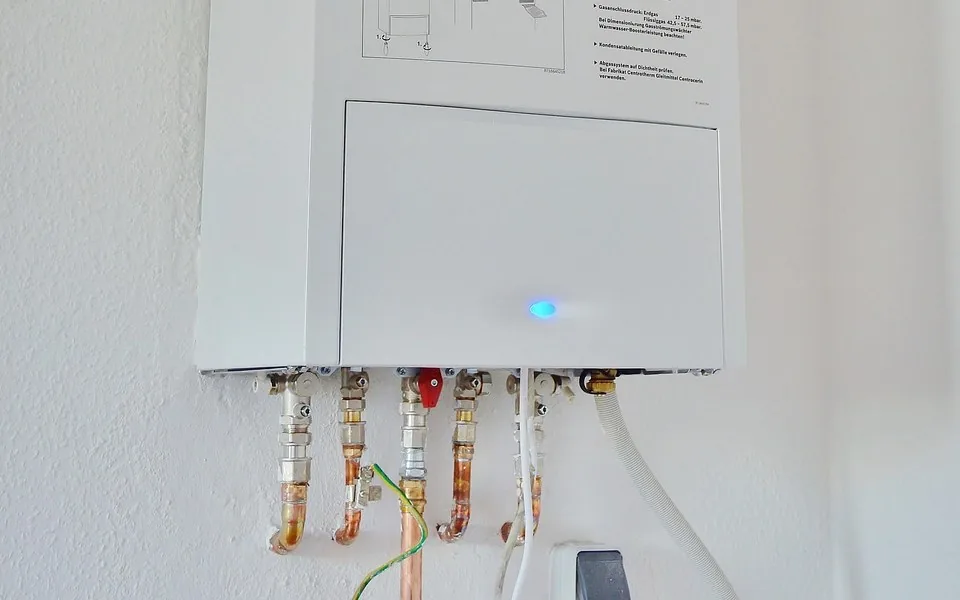
- Adequate gas line size and meter capacity for high BTU input
- Correct venting (category/type per unit) with clearances
- Combustion air as required
- Condensate handling on condensing units
Upsizing a gas line or relocating a vent can exceed the “heater only” budget. A straight swap from a 40-gallon tank is not always a straight gas job.
Electric tankless: panel reality
Electric tankless can demand serious amperage and multiple large breakers. Many mid-century Bergen panels do not have spare capacity for whole-house electric tankless without a service upgrade. Point-of-use electric units are a different (smaller) animal.
Do not invent amp ratings in marketing — the unit listing and the Authority Having Jurisdiction (AHJ — your local building department) govern the electrical path.
When tankless is the wrong call
Tankless is not automatically “the upgrade.” It is the wrong call when install cost, house infrastructure, simultaneous demand, or maintenance habits do not match the product. Use this decision table as a hiring brief — not a brochure.
Decision table: tank vs tankless vs hybrid heat-pump
| Goal / constraint | Storage tank (standard gas/electric) | Tankless (gas or electric) | Hybrid heat-pump tank |
|---|---|---|---|
| Lowest install on a simple swap | Often wins | Usually higher once vent/gas/power are real | Mid-to-high; needs space and clearances |
| Two+ showers at once in winter | Stored volume can cover short peaks if recovery keeps up | Only if chart GPM at winter rise + fuel/power support it | Stored volume helps peaks; recovery is slower in cool spaces |
| “Endless” long showers | Can run out of tank; then recovery-limited | Strong if sized; not endless above chart GPM | Strong for efficiency; still a tank volume + recovery story |
| Hard water / low maintenance appetite | Anode/flush care; less heat-exchanger descaling drama | Descaling is ownership — skip it and GPM falls | Filter/coil care per maker; still a tank with different service |
| Tight utility room / old panel / small gas meter | Often fits existing service path | May force gas line, vent, or service upgrade | Needs space, drain, and electrical path; cools the room slightly |
| Far bathroom wait time | Same pipe-run physics; recirc optional | Same pipe-run physics; recirc still a design choice | Same pipe-run physics |
| Efficiency priority (right conditions) | Good modern tanks; not the top efficiency story | High when load matches and unit is maintained | Often excellent where ambient air and space allow |
| Best fit summary | Reliable default for many Bergen homes | Right when demand + fuel + maintenance line up | Right when efficiency + tank behavior beat on-demand GPM |
Straight takeaways:
- Choose tank when you want predictable install cost, simple fuel path, and peak buffering without descaling discipline.
- Choose tankless when simultaneous GPM at cold-weather rise is proven on the chart and the house can feed gas/vent or power without fantasy.
- Choose hybrid heat-pump tank when efficiency and stored volume matter more than tankless marketing — and you have space, condensate plan, and realistic recovery expectations. It is not a tankless GPM product.
Tankless is also the wrong call when:
- Simultaneous demand exceeds what the house can fuel or power
- You will not maintain descaling (or budget treatment)
- Clearances for vent/service do not exist
- The pitch is “endless hot water” with no manufacturer chart point
Hard water & maintenance reality in North Jersey
Hard water is common enough in North Jersey municipal and well supplies that tankless ownership should assume scale risk until a water test says otherwise. Scale coats heat-exchanger passages. A scaled unit delivers less GPM than the day-one chart — which means a correctly sized install can become an undersized install through neglect.
What scaling actually does
- Reduces flow and temperature stability under load
- Triggers error codes and nuisance shutdowns on many units
- Shortens exchanger life and complicates warranty conversations when maintenance was skipped
- Makes “we sized it right” feel like a lie when the real problem is a clogged core
Undersized units that run near max output scale harder under the same water chemistry. Sizing and maintenance are the same ownership story.
Descaling schedule (practical, not magic)
Follow the manufacturer’s interval first. As a coach-level planning range for hard water:
- Harder water / heavy use: plan descaling on the order of about once a year (sometimes more often if the maker or water test says so)
- Softer water / light use: intervals stretch — still do not skip forever
- After neglected years: expect a service call that may need more than a casual flush
Many systems use isolation valves and a pump kit for vinegar or approved descaler circulation. If the install never included service valves, maintenance gets harder and more expensive. Ask for them at install, not after the first error code.
Water treatment options (choose for chemistry, not hype)
| Approach | What it is for | Tankless note |
|---|---|---|
| Water softener (ion exchange) | Reduces hardness minerals that form scale | Often the strongest protect-the-exchanger move when hardness is high |
| Point-of-use or whole-house filters | Sediment/chlorine taste; not a hardness cure by themselves | Helpful accessories; do not confuse with softener |
| Template-assisted / salt-free conditioners | Marketed scale control without salt | Performance claims vary — size and maintain as if scale still possible unless proven otherwise for your water |
| Periodic professional descaling only | Accept hardness; clean on schedule | Valid if you actually keep the schedule |
Do not invent a single “Bergen County hardness number.” Test your water or use utility reports for the address, then match treatment and descaling to that result. “Maintenance-free tankless” is a sales phrase, not a North Jersey operating plan.
Recirculation — do you actually need it?
Tankless heats water when flow demands it. It does not preheat the copper or PEX sitting in the walls. If the primary bath is a long pipe run from the utility room, you still wait for cold slug to clear — same as a tank, sometimes more noticeable because there is no residual heat in a storage vessel.
When recirc is worth it
- Long runs to a far primary suite or finished third floor
- Household hates the wait and wastes a lot of cold-to-hot purge water
- You are already opening walls or designing a whole-house water plan
Trade-offs to price honestly
- Install cost: pump, controls, return line or crossover valve strategy, power
- Energy: standby/recirc energy and heat loss in the loop if poorly insulated
- Complexity: another device to maintain; timer or demand controls matter
- Code and design: not every house gets a full dedicated return without invasive work; “comfort kit” options exist with different pros/cons
When you can skip it
- Short runs and acceptable wait times
- Point-of-use electric at a single far lav solves one complaint cheaper than whole-house recirc
- You would rather fix placement (heater closer to load) than add a loop
Bottom line: sizing the tankless does not delete pipe volume. If wait time is the complaint, design recirc or placement — do not buy a larger BTU sticker and hope.
Cost context (sizing-driven)
Tankless equipment + install typically sits above like-for-like tank replacement — most installs land in the mid thousands and up once venting, gas, electrical, and water treatment are real. The swing is less about brand stickers and more about whether the house needs infrastructure upgrades to hit the GPM chart.
Permits
Fuel, vent, and electrical changes usually need review. Confirm AHJ for the address. Do not invent fee tables.
Red flags
- Sized on “showers in the house” without simultaneous-use talk
- No cold-weather rise calculation
- Gas unit sold without line/meter check
- Electric whole-house unit sold without panel load calculation
- “Endless hot water” with no GPM chart
How to brief your installer
- List simultaneous uses (e.g., two showers + dishwasher)
- Note fuel available (gas size / electric service)
- Note far fixtures and wait-time complaints
- Share water hardness if known
- Ask for the chart point: GPM at design rise