
First, take a breath. If you're looking at water where it should not be — a soaked carpet, a damp finished basement, a ceiling that's started to bulge — many situations can be stabilized and restored when the source is controlled and the affected materials are handled promptly. You do not need to solve everything in the next five minutes. You do need a clear sequence.
Drying is only the first phase when walls, flooring, cabinetry, bathrooms, kitchens, or other finished spaces have to be rebuilt. Bergen Restoration’s home restoration work covers the transition from damage repair into finished reconstruction.
This article walks through what to do first, how professional water damage restoration works, and how water tends to show up in Bergen County homes. It supports the service overview at water damage restoration — this is the deeper “what now?” guide, not a rewrite of that page.
Bergen Restoration serves homeowners throughout Bergen County, including older basement stock and low-lying communities where drainage and stormwater problems can be recurring concerns. When you call, the first priority is safety and documentation — no scare tactics, no pressure.
What to do in the first hour
If it is safe to do so, these steps protect your household and your claim file:
- Treat electricity as the first hazard. If water is near outlets, the panel, or a running appliance, do not wade in. Shut power only if you can reach the panel dry-shod. Otherwise wait for a professional or the utility.
- Stop the source when you can identify it safely. Close the nearest applicable shutoff — a fixture or appliance valve may be enough — or the main when the situation calls for it. Do not enter an electrically hazardous area to reach a valve. If the water is coming up during a storm after a sump failed, there may be no indoor “off” switch; focus on safety and documentation.
- Photograph before you move things. Wide shots and close-ups of the water line, wet materials, and damaged contents. A short video helps. This is one of the most useful things you can do for an insurance claim.
- Lift contents off the wet floor; do not start demolition. How much comes out depends on water category and material conditions assessed on site.
- Do not run household fans on sewage or visibly contaminated water before the loss has been assessed. Uncontrolled air movement can spread contaminants.
- Call for extraction. Wet materials under the right conditions can support mold growth; EPA guidance commonly points to drying wet materials within about 24–48 hours to reduce that likelihood. The clock starts when materials get wet.
These are the immediate priorities. Professional restoration begins with source control, safety assessment, documentation, and extraction.
Why Bergen County basements get wet the way they do
National “water damage tips” lists rarely explain why water shows up here. A few local patterns matter — always verified on the property, not assumed from a town name:
- River corridors and flood-prone low ground. The Hackensack, Passaic, and Saddle River systems shape a lot of the county’s flood story. Low-lying and Meadowlands-adjacent communities (for example portions of Little Ferry, Moonachie, Carlstadt, East Rutherford, and Lyndhurst) may present shallow-groundwater, stormwater, or poor-drainage constraints. Municipal flood risk does not prove the water path at a specific house.
- Varied soils. Bergen County soils mix alluvial deposits, glacial sediments, rock outcrops, sands, silts, and localized clay — not a single countywide “clay” profile. Seepage and drainage behavior follow the lot.
- Cold joints in mid-century foundations. In many 1950s–70s block and early-poured foundations, water often enters at the cold joint where the slab meets the wall — a seam that era of construction rarely treated as a waterproof detail. After decades of settlement, and once grading fails and downspouts dump at the wall, that joint is a common path. It is not the only path.
- Sump failure during a power outage. Storms that knock out power hit finished basements hard when the pump quits at the worst moment. A battery-backup (or water-powered backup) is a strong preventive add-on in outage-prone weather.
- Storm-drain and sewer backups. In older sewered neighborhoods, heavy events can push water back through a floor drain — which may turn a cleaner loss into a contaminated one and change how the job is handled.
Knowing which pattern you are in is the difference between drying correctly and creating a second problem inside the walls. For chronic entry after storms, see also the related drainage and waterproofing services on the site; restoration handles the loss, then the long-term fix is a separate conversation.
Water category — classified on site, not from a label alone
The most important early decision on many losses is not cosmetic. It is classifying the water. Industry practice (for example IICRC S500-style guidance) uses categories that inform PPE, what can be saved, and what should come out. Category is based on conditions at the loss — source indicators, elapsed time, affected materials, and contamination signs — not on a source label alone.
In plain language:
- Category 1 — cleaner water from a supply line or similar source when conditions support that classification. When addressed promptly, many materials may be candidates for in-place drying, depending on porosity, duration of wetness, assemblies, access to cavities, and verification.
- Category 2 — gray water with meaningful contamination. Some appliance discharges and other contaminated water may fall here depending on actual conditions. A “sump overflow” is not automatically Category 2 — it depends on what the sump collected, its condition, microbial exposure, and how long the water sat.
- Category 3 — black water from sewage, rising floodwater, or other visibly or potentially contaminated sources may require Category 3 handling. Weather-related water is not automatically Category 3 — it needs site assessment. Sewage and certain wastewater backflows are common Category 3 examples.
River-corridor flooding, low-lying stormwater, and sewer backups are all real local patterns — and they are not interchangeable for cleaning and salvage decisions. A crew that skips classification to “just dry everything” can leave a health and mold problem behind. We classify first, document the category, and explain what it means for your home in plain English.
The mold window and moisture you cannot see
Under the right conditions, mold can begin to establish in materials that stay wet. That is why extraction speed matters, and why “it looks dry” is an expensive assumption. Cavities behind baseboards, under cabinets, and in joist bays can hold moisture long after the surface feels dry.
A professional assessment looks for that hidden water:
- Moisture meters (pin and pinless) read what your hand cannot.
- Thermo-hygrometers track whether the air is supporting drying.
- Infrared cameras help identify temperature anomalies that warrant confirmation with meters or further inspection. They do not directly detect moisture — insulation gaps, air leakage, thermal bridging, and HVAC effects can produce similar readings.
Then drying is engineered, not guessed: extract standing water first; size LGR dehumidifiers and air movers to the space; drive moisture out of materials into the air. Where demolition, contamination, dust, or aerosolization risk warrants it, the plan may include HEPA-filtered air-filtration equipment — that is risk-based, not a universal rule for every Category 2 or 3 job. Moisture readings are documented throughout the drying process and used to determine when materials have reached the project’s drying goals — not a calendar guess, and not “looks fine.”
Insurance and documentation (careful language)
Water losses often become insurance claims. First-day documentation often decides how smoothly the claim goes:
- Photograph and log from the start. Moisture maps, readings, and before/after photos help an adjuster verify the work. Poor notes create friction.
- Do not over-demolish early. Keep salvageable materials until documentation (and, when relevant, the adjuster) supports removal.
- Coverage is policy-specific. A sudden internal event such as a burst supply line may fall under a standard homeowners policy; surface flooding from outside may require separate flood coverage (for example NFIP or private flood). Those are directional patterns only. Coverage decisions are made by the insurer under the specific policy — language, exclusions, endorsements, source of loss, maintenance history, timing, and resulting damage all matter. We do not interpret coverage or act as a public adjuster. We document the loss so you are not fighting your own paperwork.
Mitigation vs. reconstruction
Two different jobs often get blurred:
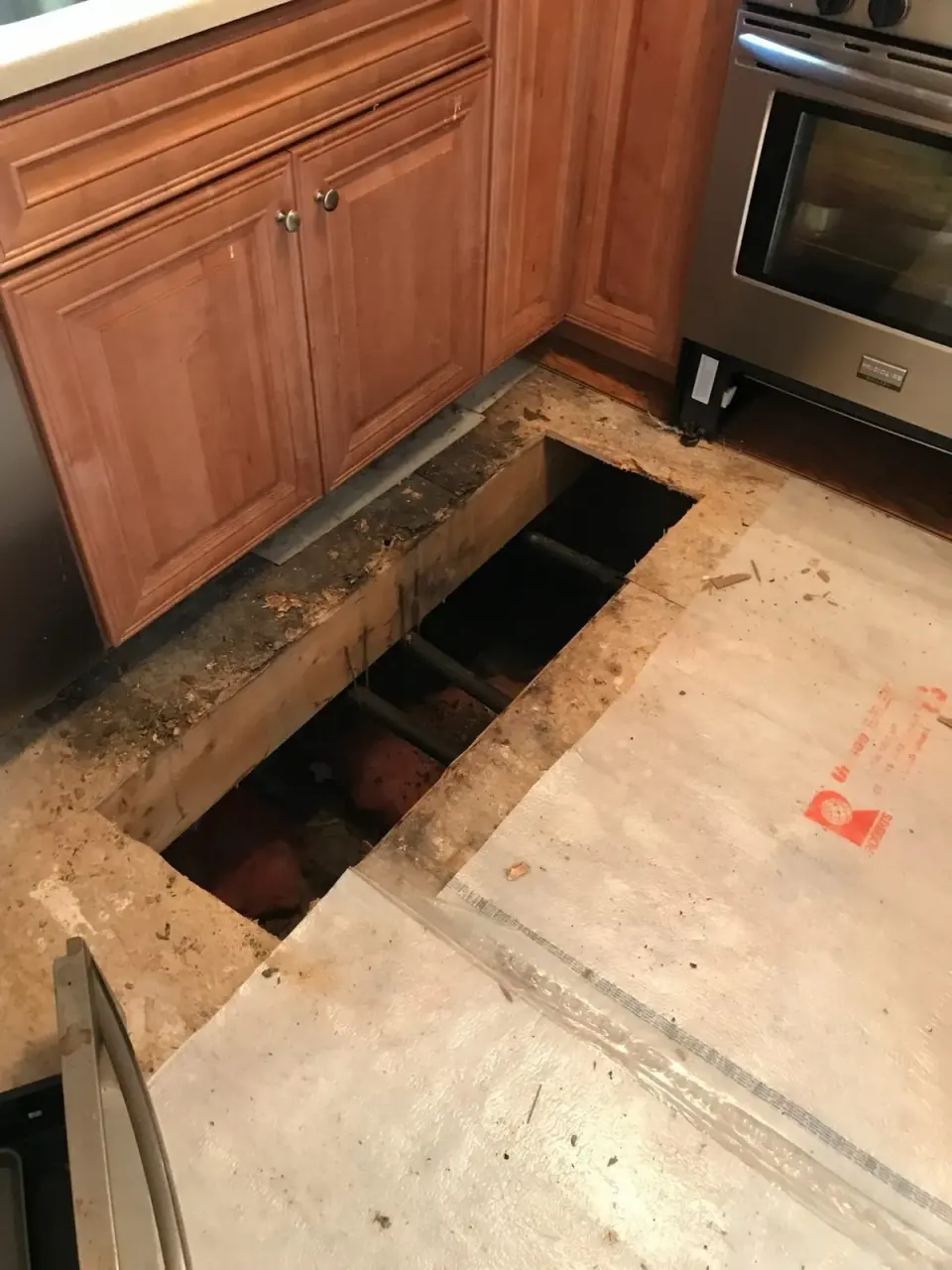
- Mitigation — extraction, drying, and documentation — usually is not a building-permit event on its own, and it comes first.
- Rebuild — replacing drywall, flooring, electrical, or plumbing that had to come out — is a separate schedule. When it opens walls or systems, it typically needs permits and inspections. Requirements vary by municipality across Bergen County; we confirm with the local building office rather than inventing a countywide rule.
Closing wet assemblies early to “get life back to normal” is how one loss becomes two. Dry and verify first; rebuild second.
Mitigation vs. mold remediation
Water damage restoration focuses on stopping the source, extracting, drying, and documenting. Mold remediation is a different, specialized scope — handled by licensed mold remediation specialists where required — for when microbial growth is already established or suspected beyond a simple moisture event; we coordinate that handoff when a loss calls for it. Jumping straight to “mold company” language without source control and drying can miss the root problem; drying without addressing contamination class can miss health risk. Start with the water loss as it actually is, then decide next steps honestly.