
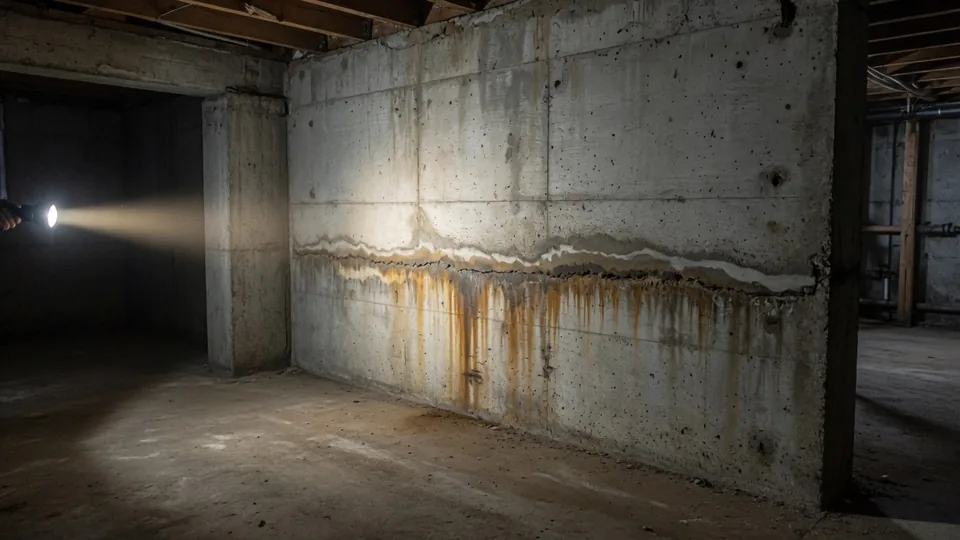
If you searched for basement waterproofing in Bergen County, you're probably not shopping for a brochure. You're looking because something downstairs isn't right — a dark line at the base of a block wall after rain, a damp corner in the finished room, a musty smell that returns every spring like a bad habit. You want someone who will stand in the basement with you, point a flashlight at the same place you're already staring, and tell you the truth without turning it into a sales production.
When the water problem has already damaged finished space, the next phase becomes home restoration — repairing and rebuilding the basement after the source is controlled.
That's what this is. The calm, neighbor version of how water gets into these houses, what usually fixes it, when digging the yard actually makes sense, how permits work in New Jersey without mythology, and what a solid next step looks like. No countdown clocks. No "sign today or the price explodes." Basement waterproofing is a considered decision for most chronic seepage. It deserves a considered conversation.
We've spent enough time under split-levels and colonials from Paramus to Teaneck to Dumont and the Meadowlands edge to know the pattern. Same era of foundations. Same storm calendar. Same places water likes to collect. Once you see the pattern, the fix stops feeling mysterious.
What you're seeing
Water in the basement hits a nerve. Storage gets ruined. A playroom starts to feel off-limits. You start wondering about mold, resale, and whether every big rain is going to be a weekend cleanup. That reaction is normal. The problem is usually more ordinary than the dread makes it feel.
In a lot of Bergen houses — especially the 1950s through 1970s stock that still dominates so many streets — the water story is not a dramatic wall failure. It's chronic seepage that shows up after the ground has been wet for a while: a multi-day rain, a thaw, a nor'easter that sits on the county. You go downstairs and find moisture at the perimeter, not a geyser in the middle of the slab.
That distinction matters. Active storm flooding and a finished-space disaster are one conversation (mitigation, drying, restoration). Recurring seepage that leaves stains, efflorescence, and damp carpet edges is another. Both need respect. They don't always need the same system.
Why Bergen County foundations leak
Here's the local physics without the jargon pile.
A huge share of single-family homes in towns like Paramus, Dumont, Teaneck, and Bergenfield went up during the post-war boom. Split-levels, bi-levels, raised ranches, colonials. Full basements or walk-outs on sloping lots. Foundations of concrete block or early poured concrete. Those walls were built to hold the house up. They were not built as a modern waterproof envelope.
The weak seam most people meet first is the cold joint — where the floor slab meets the foundation wall. It was never a factory-tight waterproof seal. Over decades of settlement, freeze-thaw, and hydrostatic pressure (groundwater pushing against and under the foundation), that joint opens just enough. After the soil saturates, water finds the path of least resistance and shows up as seepage at the cove line — the base of the walls and the low corners.
If you've ever noticed water in the same corner every time the yard stays soaked for two days, you're not imagining a curse. You're watching gravity and pressure do what they always do in this housing stock.
Near the Meadowlands corridor — East Rutherford, Carlstadt, Little Ferry, parts of Lyndhurst and lower Teaneck — a high water table can push water under slabs more aggressively. That is hydrology. It changes how a system should be designed. It does not mean a special "Meadowlands waterproofing permit office" exists. Your municipality is still the authority having jurisdiction (AHJ).
Finding where the water comes from
Good waterproofing starts with diagnosis, not product names.
Stand outside after a hard rain if you can. Then walk the basement. The map usually falls into a few buckets:
- Surface water — a downspout dumping at the foundation, soil that now slopes toward the house, a low planter pocket holding water against the wall. Often the cheapest fix, and sometimes the whole fix.
- Cold-joint / perimeter seepage — water collecting at the slab-wall seam under hydrostatic pressure. This is the classic interior-drain-to-sump case.
- A discrete crack — one path through the wall or floor. Injection or targeted repair may be enough if it's not structural and not part of a broader perimeter problem.
- Wall dampness and white mineral staining (efflorescence) — moisture moving through masonry. Sometimes secondary to seepage; sometimes a humidity problem after the free water is controlled.
- Finished-space clues — buckling laminate, swollen baseboards, a musty closet along an exterior wall. The finish materials are telling you the foundation still sees water.
If someone quotes a full exterior excavation before asking where the water shows up, when it shows up, and what your gutters and grade look like, they're selling a truck configuration — not reading your house.
The best assessment window is during or right after sustained rain, when the water is honest. Photos and videos from the last storm help when the basement is dry the day we visit.
Low-cost checks to do first
This is the part franchises quietly skip in marketing because it doesn't sell a "system."
On fifty- to seventy-year-old Bergen lots, original positive drainage often reverses. Soil settles. Patios get added. Neighbors regrade. Downspouts that once discharged several feet out now dump right at the wall like a garden hose aimed at the cold joint.
Before a perimeter system:
- Clean gutters and keep them that way — leaf load in wooded pockets of Ridgewood, Mahwah, Paramus, and similar towns will clog them again if you ignore fall.
- Extend every downspout well away from the foundation — several feet minimum when the lot allows; more is better when water currently pools at the wall.
- Look at grade. If the soil cups toward the house, re-grading is not cosmetic. It's part of the waterproofing conversation.
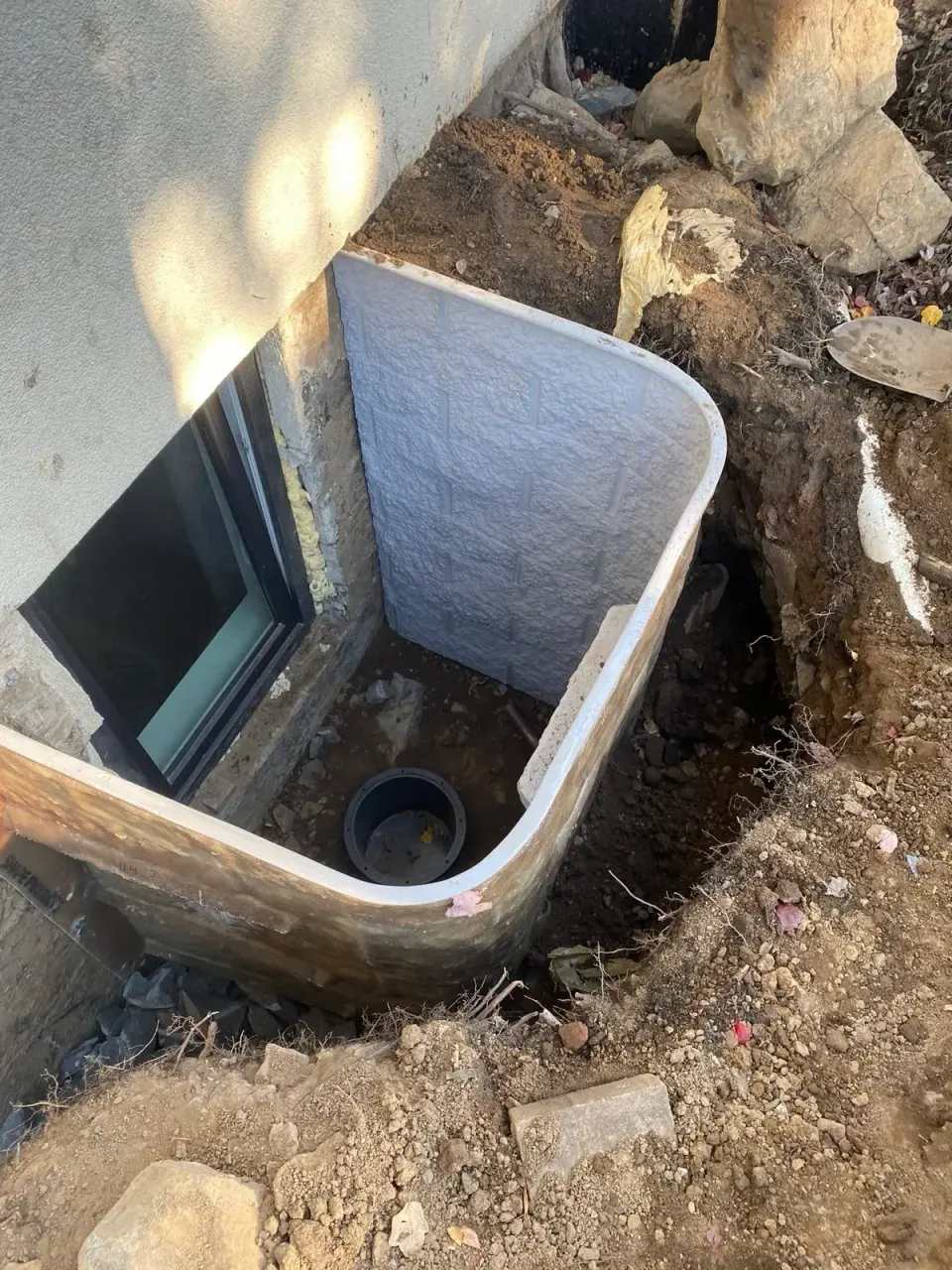
- Check window wells and exterior low spots for standing water after storms.
Sometimes those corrections take a wet basement from "every storm" to "almost never." Sometimes they reduce volume enough that the mechanical system has an easier life. Either way, a crew that starts outside is usually a crew you can trust inside.
When to stop doing it yourself
Stop when the work moves beyond safe surface drainage. Cutting the slab, excavating to the footing, changing sump discharge plumbing, and repairing a structural crack require equipment and decisions that affect the foundation or the way water leaves the property.
A wall that has shifted, bowed, or opened along a crack needs professional assessment. Repeated seepage after the gutter, downspout, and grade checks also deserves a closer look before you spend more money on sealer.
Interior perimeter drain and sump
For chronic seepage at the cold joint in typical Bergen block or poured basements, the workhorse answer is an interior perimeter drain tied to a sump pump that discharges water away from the house.
In plain English: we open a channel along the inside edge of the slab where water collects, set perforated pipe in clean stone, direct that water to a sump basin, and pump it out to a legal discharge point. The idea is not to pretend hydrostatic pressure doesn't exist. The idea is to give water a controlled path out of the living space instead of through your drywall.
Why interior so often wins here:
- It treats the entry point most of these foundations actually use.
- It avoids excavating the whole yard, tearing landscaping, and working against tight side yards common on suburban lots.
- Cost and disruption are usually lower than a full exterior dig.
- Finished basements can still be protected with containment and sequenced repair — though finishes along the work line may need careful opening and rebuild.
Sump pumps and battery backup
A perimeter drain without a working sump is a ditch with nowhere to go. A sump without a path feeding it can sit dry while the walls weep. They work as a system.
In this climate, battery backup (or another reliable backup strategy) is not luxury theater. Power outages love the same storms that flood basements. A primary pump that dies when the lights go out is a fair-weather friend. A high-water alarm and a pump sized for real storm volume are part of treating the house like it lives in northern New Jersey, not a brochure climate.
We like to say we're not magicians — we just make water leave the building on purpose. (No rabbits. Plenty of stone and pipe.)
When exterior waterproofing belongs
Exterior work — excavating to the footing, applying membrane or proper waterproofing to the wall, installing exterior drainage — stops water at the source side of the foundation. It is real craft. It is also disruptive, equipment-heavy, and usually a different budget tier entirely.
It tends to make sense when:
- Water is driving hard from the exterior wall face and interior collection alone won't manage the volume or condition.
- High water table or site conditions (including Meadowlands-adjacent hydrology) point to combination work.
- You're already excavating for another reason (addition, major foundation repair) and can fold waterproofing into open ground.
- Structural or wall conditions need exterior access.
What it does not make sense as: the automatic first pitch for every wet corner in every town. Anyone who puts every homeowner on full exterior excavation before diagnosis is selling, not mentoring your house.
Honest crews say "interior is enough" when it is — and "you need exterior or combination" when the site demands it. Both sentences can be true on different streets.
Interior vs. exterior at a glance
| Question | Interior perimeter + sump | Exterior dig + membrane |
|---|---|---|
| Yard impact | Low | High |
| Common fit | Slab-edge / cold-joint seepage; many collection cases | When exterior source control or site conditions require it |
| Cost pattern | Often lower disruption cost | Excavation + restore drive cost up |
| What it does not do | Waterproof the outside face of the wall | Guarantee results if diagnosis was wrong |
Permits in Bergen County
Homeowners ask, "Do I need a permit for basement waterproofing?" The useful answer is what scope, not a county slogan.
New Jersey guidance from the Department of Community Affairs (DCA) Construction Code Communicator (Fall 2018) is the soft research spine we use in conversation:
- For a typical interior perimeter drain in an existing basement — removing perimeter slab, installing perforated pipe in stone to manage groundwater inside the foundation — state UCC guidance has indicated there is often no building permit required for that interior drain technique alone, because there isn't a meaningful code section to inspect against during the work the way there is for many other construction scopes.
- Exception — radon: If the home has an existing passive or active radon system, cutting the slab can break seals. Then a permit path under minor-work rules can apply so the radon system is resealed properly. Don't guess; disclose radon systems up front.
- Installing a new sump pump and discharge piping where none existed always requires a permit under that same guidance path. Installer expectations track plumbing/UCC homeowner rules.
- Replacement of an existing sump pump generally does not require a permit.
- Exterior excavation, membranes, and footing drains get tighter municipal review — commonly building/construction scope, and sometimes grading or stormwater questions depending on the town and the dig.
- Discharge must follow local stormwater and property-line rules. Do not assume you can dump into the sanitary sewer. Do not dump onto a neighbor's lot or the sidewalk. Routing is confirmed with the municipality.
- Bergen County is not your building department. The AHJ is your town — Paramus, Teaneck, Ridgewood, Hackensack, Fort Lee, and so on. Neighboring towns can differ in process details even when state guidance is the same.
Soft language matters: we do not say "interior drains never need any paperwork in any town forever." We say state guidance often means no building permit for the interior drain alone, new sump/discharge is a different story, radon is an exception, exterior digs are tighter, and your municipal construction official has the last word.
Meadowlands hydrology changes system design. It does not create a separate regional permit office for waterproofing.
How the work runs
If the basement is unfinished storage, the job is mostly access, noise, concrete cutting, and cleanup. If it's a finished lower level, protection and sequencing matter as much as pipe slope.
A careful crew:
- Protects stairs, floors, and living paths.
- Opens only what the system needs along the perimeter (or targeted zones).
- Sets drain depth and slope so water actually moves to the sump — not a flat trench that silts in.
- Seals the sump basin properly and sizes discharge for the site.
- Does not "solve" the problem by painting a wall that is still under pressure.
- Leaves you with a clear explanation of what was installed and how to test it.
Coatings and "waterproof paint" on the inside of a wall with active hydrostatic seepage are negative-side coatings fighting water from the soil side. They fail. Minor dampness after seepage is controlled is a different conversation. Active free water needs drainage, not a prettier film.
What it costs
We're not going to invent a fake fixed price for every linear foot of every basement on every street. Your house writes the bid. Soft market orientation for planning in the Bergen / northern New Jersey pattern (~2026 thinking, always site-specific):
- Targeted crack work or limited drainage can sit in a lower band — sometimes low thousands depending on access and severity.
- Full interior perimeter systems with sump commonly land from several thousand into the low five figures depending on linear footage, water volume, finished conditions, and backup equipment.
- Exterior excavation is a different tier — often discussed in the $20,000–$30,000+ neighborhood and higher on tight, deep, or complex lots.
- Finished basements add real money when walls, floors, or trim must be opened and restored.
What moves the number more than a logo on a brochure: diagnosis accuracy, linear footage, interior vs exterior, sump/new discharge/backup, access, and how much finish work has to come out and go back. A phone quote without a walk-through is a guess wearing confidence.
How to choose a waterproofing contractor
When you talk to companies, listen for:
- Walk of the whole basement and exterior, not only the wet corner.
- Questions about when water appears and what grading/downspouts look like.
- Plain English about cold joint vs crack vs surface water.
- An honest interior vs exterior sentence for your site — including high water table where it applies.
- Clear talk about discharge legality and permit scope for new sump vs drain-only.
- Warranty language that says what is covered (drain, pump, labor) and whether it transfers if you sell.
- References and photos of homes like yours — era and problem pattern, not a stock vault photo from another state.
Red flags: firm price over the phone for a full system, pressure to sign today, every house gets exterior dig, coatings sold as the fix for active seepage, and shrug answers about where the water will discharge.
What a real scope includes
- Diagnosis of the water source (not just “you need our system”)
- Grade and downspout assessment
- System type and why it fits this house
- Sump discharge location and backup plan
- What is covered if water returns (warranty language in plain English)
- Protection of finished spaces
- Permit responsibilities
Keeping the basement dry afterward
A good system still likes simple habits:
- Pour a bucket of water into the sump pit periodically and watch the pump kick on. Check backup before storm season.
- Keep gutters clear; re-check downspout extensions after landscapers "tidy up."
- Watch grade after freeze-thaw winters — soil moves.
- Run a dehumidifier in finished spaces; chronic high humidity is a separate comfort and material problem even when free water is controlled.
- Walk the perimeter each spring for new settlement, staining, or efflorescence.
None of that replaces professional work when the joint is actively weeping. It keeps a solved basement from becoming a neglected one.