
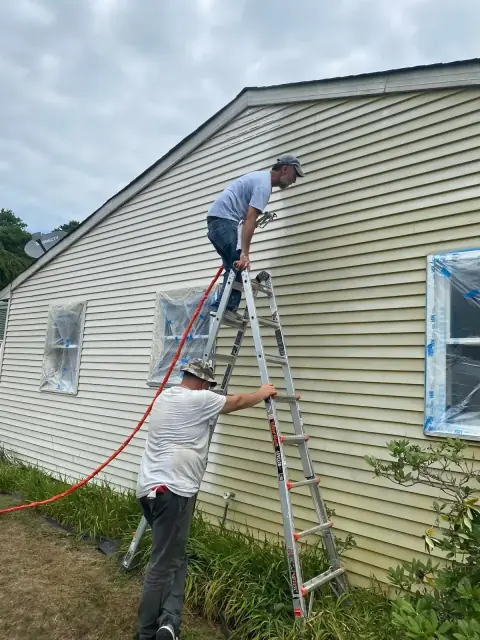
Fiber Cement Siding
James Hardie and equivalent fiber cement siding installation for Bergen County homes. Manufacturer-spec install, butt-joint flashing, primed back, and trim integration — managed by a registered NJ contractor.
Fiber Cement Siding Install
Fiber cement siding — James Hardie being the dominant brand — lasts 40–50+ years, resists fire, insects, and rot, and outperforms vinyl on impact resistance and appearance. The trade-off is higher material cost and a much more demanding install. Manufacturer warranty requires specific fastener type, blind-nail pattern, butt-joint flashing, and trim integration. An incorrect install voids the 30-year product warranty and can fail in under a decade.
- Full tear-off of existing siding to sheathing
- Sheathing repair where rot or water damage requires
- Weather-resistive barrier (house-wrap) replacement
- Butt-joint flashing between siding panels per manufacturer spec
- Stainless or galvanized blind-nail fastening to factory pattern
- PVC or HardieTrim corner boards, water table, and frieze board
- Manufacturer-approved caulking at trim transitions and penetrations
- Primed factory-finish panels (ColorPlus or equivalent) for color longevity
- Site-painted or factory-finish color selection per project
Fiber cement is installed by crews experienced specifically with manufacturer-spec methods. The product is heavier than vinyl, dust hazardous when cut, and unforgiving of incorrect fastening — the install standard matters as much as the product choice.
Serving homeowners throughout all 70 Bergen County municipalities. View our Bergen County service areas.
Fiber Cement Siding Guides
Decisions that determine whether you get the 40-year service life.
Why Fiber Cement Installs Fail
- Ground & roof clearances: boards need specified gaps above grade, decks, and roof lines — buried edges wick water and swell.
- Butt-joint flashing: joints get flashing behind them per spec; caulk-only joints open and streak within a few winters.
- Nailing spec: correct nails, correct depth, into studs — overdriven nails crush the board and void the install.
- Kickout flashing: where roof meets wall, the small kickout diverter keeps years of runoff out of the wall assembly.
- Gap & seal discipline: specified gaps at trim, sealed with the sealant class the manufacturer names — not whatever is on the truck.
Planning a project like this? Get an estimate.
Factory Finish vs Field Paint
- Factory finish: color baked on in controlled conditions with a 15-year finish warranty from the manufacturer — consistent film, no weather variables.
- Field paint: full color freedom and easier future changes; quality then depends on prep, temperature, and the painter’s schedule.
- Repaint cycles: factory finishes typically run 15+ years before repaint; field paint on fiber cement runs 10–15 — both far beyond wood.
- Touch-up reality: factory colors are matched from manufacturer codes; field colors need the formula kept on file.
- Cost logic: factory finish costs more up front and usually less per year of service.
Planning a project like this? Get an estimate.
Smooth or Cedar Texture
- Cedar texture: embossed grain reads traditional and forgives dust and minor surface wear — the default in most Bergen County neighborhoods.
- Smooth: crisp shadow lines and a modern read; it shows nail touch-ups and surface flaws more honestly.
- Match the architecture: colonials and capes usually want texture; contemporary and transitional facades earn smooth.
- Mixing planes: smooth panels or trim against textured lap is a deliberate designer move — fine when intentional, odd when accidental.
- Check in person: texture reads differently at wall scale than on a hand sample; look at an installed wall before committing.
Planning a project like this? Get an estimate.
Weight, Cutting & What Your Walls Carry
- Wall loading: the weight spreads across the whole frame; standard wood-framed homes carry it without modification.
- Stud fastening: nails go to studs, not just sheathing — layout discipline vinyl installs never needed.
- Cutting control: shear or score-and-snap cutting with dust management — silica dust is a real jobsite discipline, handled with rated extraction.
- Two-person handling: 12-foot planks install flat and straight only with proper crew handling; solo-hung fiber cement shows it.
- Why it matters to you: the same mass that demands careful install is what shrugs off hail, ladders, and baseballs for decades.
Planning a project like this? Get an estimate.
What Maintenance It Actually Needs
- Annual rinse: a garden-hose wash keeps grime and organic shadow off the finish; no pressure washer needed or wanted.
- Caulk watch: sealant joints at trim and penetrations are the only consumable — inspect every few years, renew as they age.
- Gutter discipline: overflowing gutters streak any cladding; fiber cement forgives it longer but not forever.
- Repaint horizon: plan the repaint in decade terms, not years — and the substrate under the paint will still be flat and sound.
- No pests, no rot: nothing eats it and water does not swell it — the maintenance list stays this short for the life of the wall.
Planning a project like this? Get an estimate.
Cost & Value vs Vinyl
- Where the money goes: heavier material, stud-nailed install, flashing details, and finish work — the premium is labor and spec, not markup.
- Service life: 40–50 year substrate life against vinyl’s 20–30 — roughly two vinyl cycles per fiber cement wall.
- Resilience: hail, impact, and fire performance in a different class; it neither melts near grills nor cracks in cold snaps.
- Curb appeal: deeper shadow lines and painted-wood presence — the look premium buyers read instantly.
- Honest fit: on a starter home or a five-year horizon, vinyl’s math often wins; on a long-hold home in a premium neighborhood, fiber cement’s does.
Planning a project like this? Get an estimate.
Your Fiber Cement Siding Process
Inspect & diagnose
Evaluate crack width, pattern, location, and whether water is present or seeping. Determine whether the crack is structural, cosmetic, or moisture-driven.
Select repair method
Recommend epoxy, polyurethane, carbon fiber reinforcement, or engineering coordination based on findings. We explain the options before anything is scheduled.
Prep & seal
Clean the crack, install injection ports where applicable, inject sealant, and apply surface seal. Carbon fiber straps installed where lateral pressure is a concern.
Waterproof & coordinate drainage
Apply waterproofing membrane over repaired sections. If water pressure from drainage is the root cause, coordinate French drain, sump pump, or yard drainage work.
Frequently Asked Questions
Fiber cement siding from major manufacturers carries 30–50-year product warranties when installed to manufacturer specification. Actual service life typically exceeds 40 years on Bergen County homes. ColorPlus factory finish carries 15-year color warranty; site-painted color longevity depends on paint product.
Higher material cost, much higher installation labor (weight, cutting precision, specialized fasteners), and trim integration drive the price. Trade-off is significantly longer service life, better appearance, fire resistance, insect resistance, and higher resale value.
Yes — primed factory-painted product accepts repaint cleanly when color change is desired. ColorPlus factory finish lasts longer than typical site-paint; site-painted product needs repaint roughly every 10–15 years.
Depends on plan. Homeowners staying long-term value the 40-year service life and lower maintenance. Homeowners selling within 5–7 years often see resale value advantage from premium siding. Vinyl is more cost-effective for shorter-hold properties.
Yes. Bergen Restoration is a registered New Jersey Home Improvement Contractor (NJHIC# 13VH08865500) with commercial general liability and workers’ compensation coverage; documentation available on request.
Clearance and flashing details: gaps at roofs and grade, kick-out flashing, sealed cut ends. The product is nearly indestructible; sloppy detailing is the only way to kill it.
Factory color bakes on with long warranties; field paint offers any color with a repaint horizon. Both legitimate — the trade is palette freedom versus coating longevity.
It's heavier than vinyl and wants proper nailing into framing — standard for a competent crew, and part of why installs cost more. Your walls don't care; the installer's schedule does.
Smooth reads modern, cedar-mill reads traditional Bergen colonial. Same performance — this one really is pure style.
Noncombustible and dent-resistant — the insurance-friendly siding. It's the reason fiber cement owns the premium re-side conversation.
A rinse and a caulk-joint check occasionally; repaint on the field-paint cycle if you chose paint. Compared with wood it's a hobby, not a job.
Part of our Exterior & Envelope family. See also Siding Repair & Replacement, Vinyl Siding, and Exterior Painting.
Get Your Estimate
Tell us about your foundation crack or moisture concern. We’ll follow up with the next best step.
Commercial general liability and workers’ compensation coverage. Documentation available on request.
Let’s Talk About Your Project
Tell us what you have in mind — we’ll follow up with a plan.