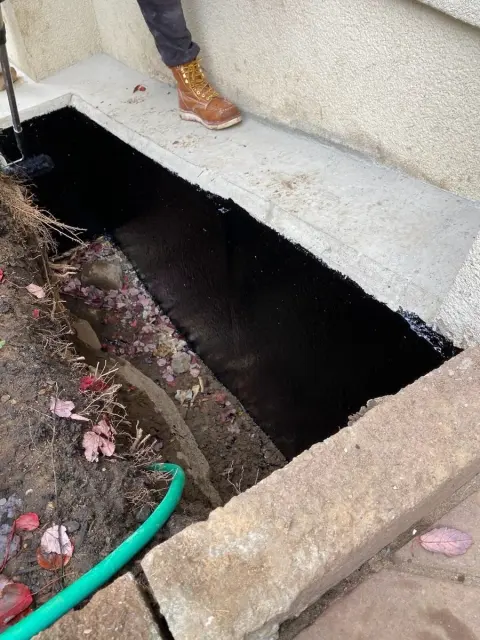
Exterior foundation waterproofing membrane applied at a Bergen County home
Home / Resources / Article

Basement Waterproofing in Bergen County: Stop the Water at the Source

Stop basement water at the source: diagnose seepage, interior vs exterior systems, costs, sump backup, and what coatings cannot fix.

Straight answer: basement waterproofing is not one product. It is a diagnosis — where water is coming from — and then a system that matches that path. In Bergen County, a lot of wet basements are mid-century foundations plus fifty years of settled grade and downspouts that dump at the wall. The fix that works is the one that hits the real source, not the one that looks impressive on a flyer.

This article is the decision guide: what is actually failing, interior vs. exterior, what coatings can and cannot do, cost drivers, and what to demand in a scope. It supports the service overview at basement waterproofing.

Diagnose first — ideally when it is wet

The best assessment happens during or right after heavy rain, when the entry path is visible. Eyeballing a dry basement in August and guessing is how people buy the wrong system.

Common Bergen patterns (verify on the property — not from a town name alone):

  • Cold joint / slab-edge seepage. In many 1950s–70s block and early-poured foundations, water often shows at the base of the walls and corners where the slab meets the wall. That seam was rarely a true waterproof detail. Settlement, hydrostatic pressure, and failed grade make it a common path — not the only one.
  • Surface water. Reversed grade, short downspouts, neighbor runoff on tight lots. Sometimes the “waterproofing” job is grading and discharge — not a new drain.
  • Flood-prone / low-lying ground. Meadowlands-adjacent and other low areas may present shallow groundwater or stormwater constraints. Municipal flood risk does not prove the mechanism at your house.
  • Finished basements. Water in a lived-in lower level raises the stakes: protection during work, drying, and what “success” means for flooring and finishes. Split-levels and colonials across towns like Paramus, Teaneck, Dumont, and Ridgewood often have finished or semi-finished lower levels — the same cold-joint pattern, higher consequences when carpet and drywall are involved.
  • River corridors and low ground. The Hackensack, Passaic, and Saddle systems shape a lot of regional flooding. Low-lying and Meadowlands-adjacent pockets (portions of Little Ferry, Carlstadt, East Rutherford, Lyndhurst, Moonachie) deserve careful site diagnosis — not a one-system slogan.

Efflorescence (white mineral powder) is a moisture clue, not just a cleaning chore. Chronic dampness after storms is a system problem, not a mop problem.

Cheap fixes first: grade and downspouts

Before anyone cuts a slab or digs a yard, check the free-ish moves:

  1. Extend downspouts well away from the foundation
  2. Re-establish positive grade away from the house where possible
  3. Clear gutters (wooded lots in places like Mahwah, Ridgewood, and parts of Paramus load gutters hard in leaf season)

A real share of “wet basements” improve when roof water stops loading the foundation line. If a contractor never looks at grade, they are selling a system, not solving your lot.

The systems that actually stop water (matched to the path)

Interior perimeter drain + sump

A channel cut along the inside edge of the slab, perforated pipe in clean stone, routed to a sump that discharges away from the house. This is a frequent, appropriate fix when water enters at the slab edge / cold joint. It collects water at the interior path and relieves pressure at that edge. It does not waterproof the exterior face of the foundation — and it does not automatically fail for groundwater or hydrostatic cases. Interior perimeter + sump is commonly used for those conditions when the design fits the assembly, drain elevation, and outlet.

Exterior foundation waterproofing membrane applied at a Bergen County home

In storm-outage weather, a battery backup (or equivalent secondary power) on the sump is a serious design detail — pumps fail when the grid fails, often at the worst moment.

Exterior membrane + footing drain

Excavate to the footing, apply a foundation waterproofing membrane, install exterior drainage, restore grade. More disruptive and more expensive. It can be the right tool when the site needs exterior control, access allows the dig, or interior-only work has already failed for documented reasons. It is not automatically “the real answer” for every high-groundwater lot or every Meadowlands-adjacent address.

Crack repair

Hydraulic cement or injection for appropriate cracks; structural cracks may need engineering — not a coat of paint.

Coatings and “waterproof paint”

Interior masonry coatings can be part of a finished look after water is controlled. They are not a substitute for drainage and pressure relief under active hydrostatic load. Paint is not a pump.

Combinations

Many houses need more than one tool: grade + interior drain, or exterior work on one elevation and interior collection on another. Honest scopes say that.

Interior vs. exterior — a straight comparison

Question Interior perimeter + sump Exterior dig + membrane
Yard impact Low High
Common fit Slab-edge / cold-joint seepage; many collection cases When exterior source control or site conditions require it
Cost pattern Often lower disruption cost Excavation + restore drive cost up
What it does not do Waterproof the outside face of the wall Guarantee results if diagnosis was wrong

Neither column is a town stereotype. The water path on your lot decides.

What it costs (ranges, always site-specific)

Broad trade patterns (~2026), site-specific:

  • Interior perimeter + sump: a typical package sits around low–mid thousands to roughly $10k+ depending on linear footage, access, finished-basement protection, and discharge
  • Full exterior dig / membrane: commonly lands around $20k–$30k+** with restore and site difficulty

What moves the number: footage, interior vs. exterior, rock and utilities, finished space protection, discharge rules, landscaping and hardscape restore, and whether a sump backup is included. Interior jobs commonly run on the order of a few days; exterior work runs longer and is more weather-sensitive.

No honest phone price replaces a walk-through when water is visible.

Permits — confirm the Authority Having Jurisdiction (AHJ — your local building department)

Requirements vary by municipality and scope. Directional patterns only:

  • Typical interior perimeter work in an existing basement often does not need a building permit under some state guidance — confirm your town; radon-system homes may need extra review when the slab is opened
  • New sump + discharge often needs a plumbing/construction permit; straight pump replacement often does not — confirm AHJ
  • Exterior dig / membrane commonly involves construction permits, utility locate, and stormwater-aware discharge rules

Stormwater/groundwater systems generally should not discharge to sanitary sewers unless expressly permitted. We verify before construction — not after the trench is open.

How the work usually runs (once the system is chosen)

Interior path (typical): protect finished areas → cut slab edge trench → place pipe and clean stone → install sump and discharge → connect backup if in scope → restore floor edge → water-test discharge. Days, not months — still disruptive if the basement is finished.

Exterior path (typical): utility locate → excavate to footing → membrane and exterior drain → backfill with attention to grade → restore hardscape and plantings as scoped → verify discharge. Longer, weather-sensitive, and more neighbor-visible on tight Bergen lots.

Either path should end with a clear answer to: Where does the water go, and what happens when the power fails?

What a real scope includes

  • Diagnosis of water source (not just “you need our system”)
  • Grade and downspout assessment
  • System type and why it fits this house
  • Sump discharge location and backup plan
  • What is covered if water returns (warranty language in plain English)
  • Protection of finished spaces
  • Permit responsibilities

Red flags

  • Coatings sold as the full fix for active seepage
  • “Exterior is always better” or “interior never works for high water” as a slogan
  • No mention of grade or downspouts
  • No sump backup conversation in a storm-prone power-outage climate
  • Warranty that sounds unlimited until you read the exclusions

Frequently Asked Questions

For the right water path — yes. Interior perimeter drains to a sump are a standard approach for slab-edge and many collection problems. They must be designed and discharged correctly; they are not magic, and they are not a scam by category.

Not if the problem is pressure and drainage. Control water first; coatings are not a pump.

Only if diagnosis and site conditions say so. Access, cost, and water path all matter. Do not buy a dig because a brochure prefers digs.

Interior systems often a few days on site; exterior longer with restore and weather. Active flooding may need mitigation first, then waterproofing as a planned project.

The drain collects; the sump discharges. In outage-prone storms, backup power is part of a serious design, not an upsell cartoon.

Next step

If your Bergen County basement wets after rain — cold-joint seepage, ponding at the foundation, or a finished lower level at risk — get a diagnosis when the water is visible. Bergen Restoration will walk the source, tell you whether grade alone, interior collection, exterior work, or a combination fits, and put it in a written scope with honest ranges.

Service overview: basement waterproofing in Bergen County.

Related reading on this site’s water cluster: French drains and water damage restoration when you are past chronic seepage and into an active loss.

Get Your Estimate

Ask about basement waterproofing in Bergen County. We’ll follow up with the next best step.

Call Us
(862) 420-0509
Tap to call
Email
info@bergenrestoration.com
Replies within 1 day
Service Area
Bergen County, NJ
Residential projects only
Hours
Mon–Sat · 8 AM–6 PM
24/7 emergency intake
Registered & Insured
NJHIC# 13VH08865500

Commercial general liability and workers’ compensation coverage. Documentation available on request.

Let’s Talk About Your Project

Service is pre-selected for basement waterproofing. Add details and we’ll follow up with a plan.