
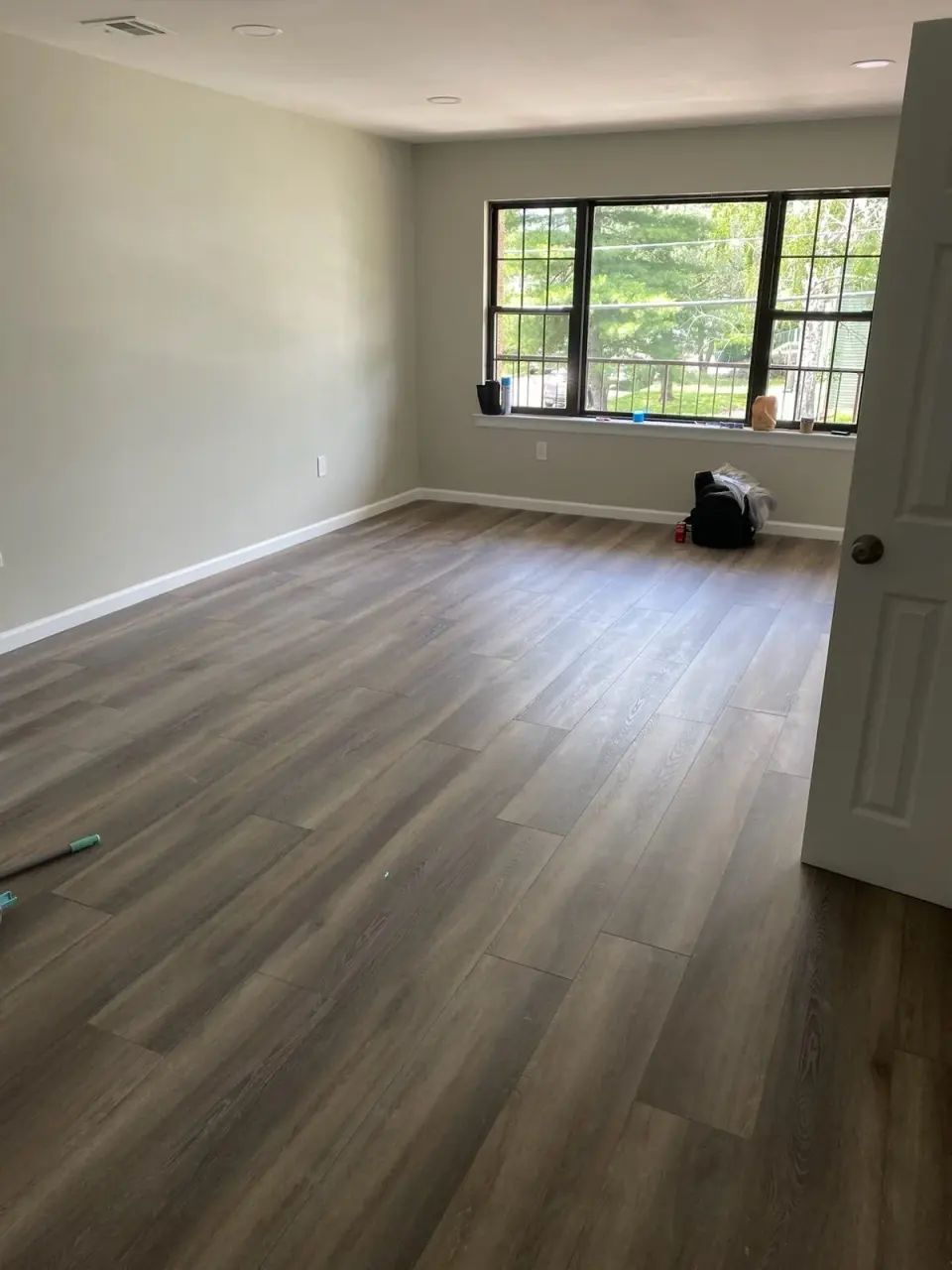
LVP Flooring
Luxury vinyl plank and rigid-core flooring installation for Bergen County homes. SPC and WPC waterproof products, click-lock floating install — managed by a registered NJ contractor.
LVP & Rigid-Core Flooring Install
LVP (luxury vinyl plank) and rigid-core products (SPC and WPC) have taken over the practical-flooring category in residential homes. Waterproof, dimensionally stable, quick to install, and increasingly convincing as a hardwood look-alike. The trade-off vs. real hardwood is resale value and longevity beyond 15–20 years. For kitchens, baths, basements, and homes with kids and pets, LVP is often the more rational choice.
- Subfloor inspection and preparation
- Underlayment installation when product does not include attached pad
- SPC (stone-plastic composite) rigid-core install — most dimensionally stable
- WPC (wood-plastic composite) install — softer underfoot
- Click-lock floating install over most subfloor types
- Around-cabinet and around-fixture cutouts in kitchens and baths
- Stair-nose and transition profile install
- Quarter-round or baseboard reset after install
- Old flooring removal and disposal
LVP is dimensionally stable across most temperature and humidity ranges. Floors larger than 30′×30′ or with significant temperature swings may need expansion joints per manufacturer spec.
Serving homeowners throughout all 70 Bergen County municipalities. View our Bergen County service areas.
LVP Flooring Guides
Decisions that determine whether the product matches what you need.
What Separates Cheap LVP From Good
- Wear layer: the number that is the floor’s lifespan: 12 mil is builder-grade, 20 mil is the residential quality line, 22+ mil shrugs off dogs and gravel.
- Core density: dense SPC cores resist dents from chair legs and dropped pans; airy budget cores dimple and stay dimpled.
- Print & emboss: quality lines pair registered embossing with low pattern repetition — cheap floors repeat the same plank photo every few feet.
- Attached pad: built-in underlayment quality drives sound and feel; the flimsy foam on budget lines flattens within a year.
- Locking profile: thicker milled locks survive install stress and seasonal movement; thin locks chip at install and gap by spring.
Planning a project like this? Get an estimate.
How Flat Is Flat Enough
- The spec: 3/16″ over 10 feet is the standard flatness tolerance — tighter than most existing subfloors actually are.
- Why it matters: planks over voids flex, click at the locks, and eventually break them; over humps they rock and gap.
- Leveling work: grinding highs and feathering lows with patch compound is normal scope on real houses, not an upsell.
- Moisture check: slabs get tested before install — LVP is waterproof, but trapped slab moisture still finds the walls and trim.
- What it rides over: existing tile and sheet vinyl can stay if flat and bonded; carpet and its tack strips never stay.
Planning a project like this? Get an estimate.
Rigid Core or Flexible
- SPC (stone core): the dense, dent-resistant default for kitchens, mudrooms, and busy first floors; slightly firmer underfoot.
- WPC (wood-polymer): thicker, warmer, quieter core at a small premium — the comfort pick for bedrooms and basements.
- Flexible glue-down: fully adhered thin plank: nothing to flex, easy single-plank repairs, common in rentals and commercial — feels most like the subfloor under it.
- Temperature swings: rigid cores handle sunroom-grade temperature swings better than early-generation flexible products ever did.
- One system per floor: mixing core types room-to-room creates height and feel changes at every doorway — pick one and run it.
Planning a project like this? Get an estimate.
Transitions, Gaps & Whole-Floor Runs
- Expansion gaps: a perimeter gap at every wall and fixed object, hidden under base and shoe — pinch the raft and it buckles mid-room.
- Run-length limits: manufacturers cap continuous runs (commonly around 50 feet) before requiring a break — relevant in long open plans.
- Doorway strategy: quality installs run plank through aligned doorways without transition strips where the spec allows — fewer bars underfoot, cleaner sightline.
- Meeting other floors: tile, hardwood, and carpet junctions get purpose-made transitions at matched heights, planned before install.
- Direction: same rules as hardwood — long axis of the space, toward the light, one direction per connected level.
Planning a project like this? Get an estimate.
Waterproof — the Fine Print
- What waterproof means: spills, pet accidents, and wet boots sitting on the surface for hours do nothing — genuinely.
- What it doesn’t: water reaching the subfloor at edges and cutouts still soaks wood subfloor, trim, and drywall — the plank survives; the room may not.
- Flooding events: a failed supply line still means insurance and drying protocols; LVP improves the odds, it is not a flood strategy.
- Wet-room detail: bathrooms and laundry rooms get sealed perimeters and caulked fixtures — small details, most of the real-world protection.
- Below grade: LVP is the basement flooring answer precisely because slab moisture vapor does not swell it — with a tested slab underneath.
Planning a project like this? Get an estimate.
Cost & Timeline Guide
- 2026 range: $5–$10 per sq ft installed, including standard subfloor prep, install, and transitions.
- The tier spread: budget products sit at the low end; premium SPC with thick wear layers and convincing texture at the top.
- Line-itemed: subfloor leveling beyond standard prep, furniture moving, and old floor disposal are separate estimate lines.
- Timeline: most single floors install in 1–2 days; no acclimation stack, no cure time — furniture returns the same day.
- Whole-first-floor jobs: continuous multi-room installs run 2–3 days with layout planning doing the heavy lifting.
Planning a project like this? Get an estimate.
Your LVP Flooring Installation Process
Inspect & diagnose
Evaluate crack width, pattern, location, and whether water is present or seeping. Determine whether the crack is structural, cosmetic, or moisture-driven.
Select repair method
Recommend epoxy, polyurethane, carbon fiber reinforcement, or engineering coordination based on findings. We explain the options before anything is scheduled.
Prep & seal
Clean the crack, install injection ports where applicable, inject sealant, and apply surface seal. Carbon fiber straps installed where lateral pressure is a concern.
Waterproof & coordinate drainage
Apply waterproofing membrane over repaired sections. If water pressure from drainage is the root cause, coordinate French drain, sump pump, or yard drainage work.
Frequently Asked Questions
Yes — SPC and WPC rigid-core LVP products are fully waterproof, not just water-resistant. Spills, pet accidents, and even minor flooding events do not damage the plank itself. The subfloor may still need attention if water sits long enough to seep through plank joints.
Most Bergen County 800–1,200 sq ft installations complete in 2–4 working days, including subfloor preparation, install, transitions, and baseboard or quarter-round reset. Faster than hardwood because no acclimation period and no finishing step.
LVP performs neutral on resale — appraisers and buyers treat it as functional flooring rather than premium hardwood. Real hardwood typically delivers higher resale impact, especially in higher-end Bergen County markets. LVP is the practical choice for owners who plan to enjoy the home long-term over selling soon.
LVP installation runs $5–$10 per sq ft installed in 2026 ranges, including subfloor prep, install, and transitions. Budget products at the lower end; premium SPC with thick wear layers and convincing wood-look at the higher end. Subfloor leveling, furniture removal, and old floor disposal are line-itemed separately.
Yes. Bergen Restoration is a registered New Jersey Home Improvement Contractor (NJHIC# 13VH08865500) with commercial general liability and workers’ compensation coverage; documentation available on request.
Wear-layer thickness, core density, and locking-edge engineering — the spec triangle that decides how it survives chairs, dogs, and sun. The photo layer everyone shops by is the least of it.
Flatter than most houses are — LVP telegraphs humps and clicks apart in dips. Skim-leveling is the unglamorous step that separates our installs from the peaky ones.
Yes — floating floors move as one raft, and perimeter gaps under trim let them. Pinning a raft with cabinets or transitions is the classic click-floor failure.
At doorways with proper profiles, height-matched to tile and wood neighbors — planned before ordering so transitions land under closed doors, not mid-hall.
Long continuous runs are its strength — with manufacturer run-length limits respected and expansion breaks hidden at natural thresholds. One surface, whole floor, very livable.
Rigid (SPC) cores hide subfloor sins better and feel firmer; flexible glue-down suits some slabs and repairs simpler. Substrate and room use pick the core.
Part of our Flooring Installation service family — explore Hardwood Flooring, and Tile Flooring.
Get Your Estimate
Tell us about your foundation crack or moisture concern. We’ll follow up with the next best step.
Commercial general liability and workers’ compensation coverage. Documentation available on request.
Let’s Talk About Your Project
Tell us what you have in mind — we’ll follow up with a plan.