
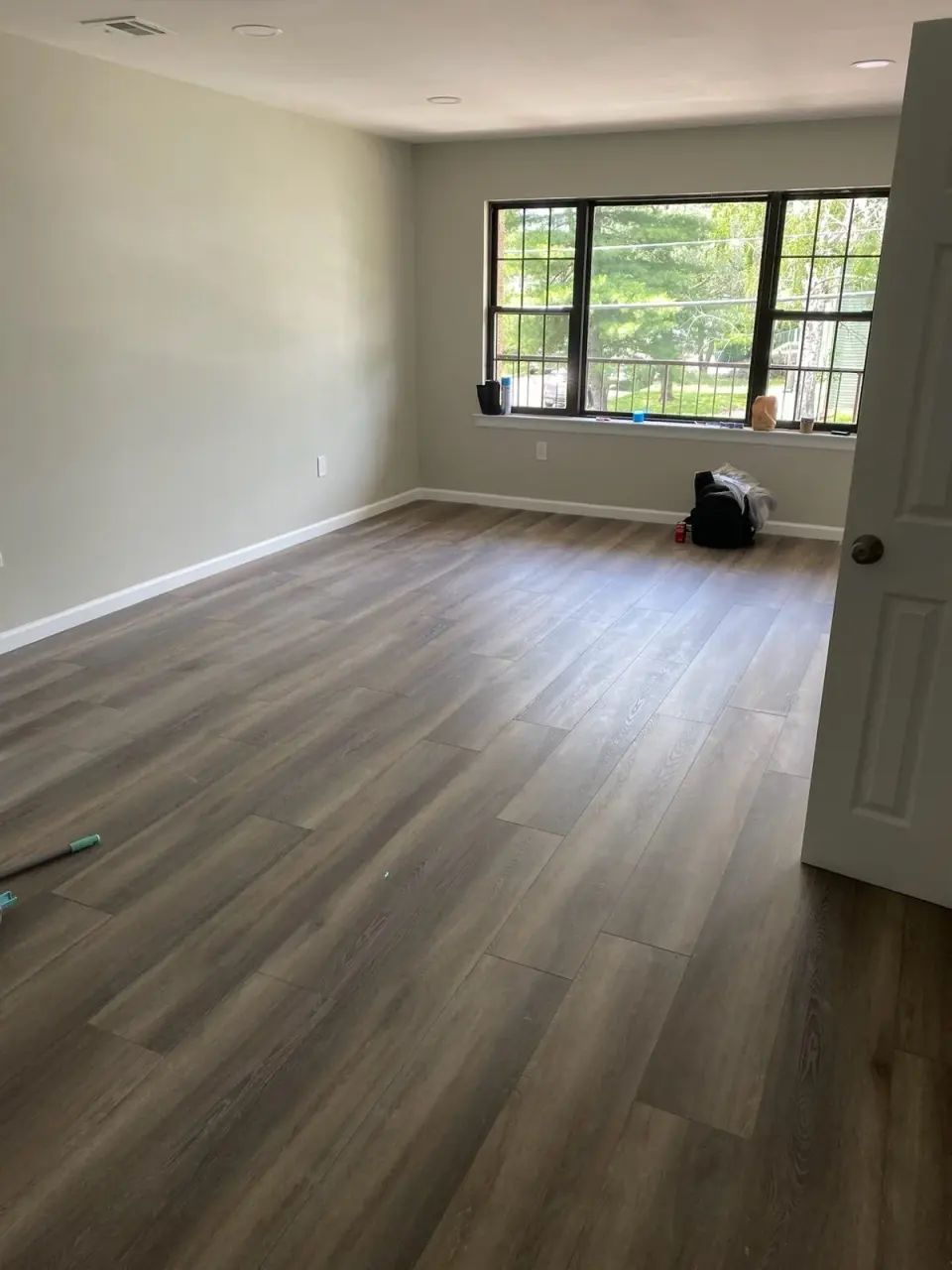
Tile Flooring
Porcelain, ceramic, and natural stone tile floor installation for Bergen County homes. Proper subfloor prep, decoupling membrane, and thinset selection — managed by a registered NJ contractor.
Tile Floor Installation
Tile flooring is the longest-service flooring option when installed correctly — 50+ years is common. The install fundamentals matter more than the tile selection: subfloor flatness, deflection limit, decoupling membrane, correct thinset, and proper grout. Cracked grout and lifting tiles almost always trace back to a missed install step, not a defective product. Porcelain has overtaken ceramic for most floor applications; natural stone remains the premium choice with its own maintenance considerations.
- Subfloor inspection — deflection, flatness, and moisture
- Cement board, Ditra, or equivalent uncoupling membrane installation
- Waterproofing membrane for showers, baths, and wet-area floors
- Porcelain, ceramic, and natural stone tile install
- Large-format tile (12′′x24′′+) with appropriate thinset and back-buttering
- Pattern layout (straight, brick, herringbone, diagonal) per project
- Premium thinset (large-and-heavy tile rated where applicable)
- Grout work in epoxy or modified cementitious with appropriate sealer
- Schluter or equivalent transition profiles at tile-to-other-flooring
Natural stone (marble, travertine, slate, granite) requires specific sealers and maintenance practices. We coordinate with stone specialists when project complexity warrants.
Serving homeowners throughout all 70 Bergen County municipalities. View our Bergen County service areas.
Tile Flooring Guides
Decisions that determine whether the tile floor holds 50 years.
Porcelain vs Ceramic
- Density: porcelain is fired denser and harder — near-zero absorption, the floor-rated standard; ceramic is softer, cheaper, and happiest on walls.
- Where ceramic is fine: backsplashes, wall fields, and light-traffic powder room floors — with honest expectations.
- Through-body vs glazed: through-color porcelain hides chips invisibly; glazed tile shows the body at any chip — relevant in kitchens.
- Ratings that matter: PEI wear class for traffic and DCOF slip rating for wet areas — two spec-sheet numbers worth reading before falling for a look.
- Wood-look planks: porcelain wood-plank tile delivers hardwood reads in wet rooms hardwood cannot live in — the category’s best trick.
Planning a project like this? Get an estimate.
Why Tile Cracks — and How It’s Prevented
- Deflection check: floors get assessed for stiffness first; tile over a bouncy floor is a countdown, not an install.
- Decoupling membrane: the uncoupling layer (Ditra and peers) absorbs subfloor movement instead of passing it to the grout and tile above.
- Flatness: large-format especially demands a flat plane — self-leveling underlayment is routine scope, not exotic.
- Movement joints: soft joints at perimeters and thresholds let the assembly breathe; grout-hard corners are where cracks start.
- Full coverage: proper trowel technique and back-buttering eliminate the hollow voids that become cracked corners under a dropped pot.
Planning a project like this? Get an estimate.
What Large-Format Tile Demands
- Flatness times two: a long tile bridges dips a small tile would follow — lippage between neighbors is the tell of a rushed substrate.
- Leveling systems: clip-and-wedge systems hold faces flush while thinset cures — standard practice at this scale, not optional.
- Mortar spec: large-and-heavy-tile mortars hold the plane without slump; bag choice is engineering here.
- The offset rule: long tiles stagger at a third, not a half — the 50% brick offset amplifies factory bowing at the tile middles.
- Layout math: fewer, bigger tiles make cut placement visible; the dry layout deciding where cuts land is design work worth doing slowly.
Planning a project like this? Get an estimate.
Grout That Stays Clean
- Cement grout: the classic: economical, proven, and porous — it needs sealing and re-sealing to stay the color you chose.
- High-performance cement: polymer-modified lines resist stain and shade variation far better for a modest premium — the current sweet spot.
- Epoxy: effectively stain-proof and waterproof — the showers-and-kitchens answer, at a real material and labor premium.
- Color strategy: mid-tone grout matched near the tile hides wear; high-contrast white lines are a maintenance commitment in traffic paths.
- Joint width: rectified tile takes tight 1/8″ joints that read seamless; pressed-edge tile needs wider joints — the tile edge decides, not preference.
Planning a project like this? Get an estimate.
Heated Tile Floors
- How it goes in: electric cable or mat sits in the mortar bed under the tile — added during install for a fraction of retrofit cost.
- The moment: a floor being tiled anyway is the once-per-decades window; adding heat later means removing the floor.
- Operating logic: programmable thermostats warm the floor for morning and evening windows — comfort heat, modest operating cost.
- Where it earns it: bathrooms, mudrooms, and slab-based kitchens — anywhere bare feet meet tile in January.
- Membrane synergy: current uncoupling membranes carry the heat cable in one layer — decoupling and heating install as a single system.
Planning a project like this? Get an estimate.
Cost & Timeline Guide
- 2026 range: $12–$22 per sq ft installed including subfloor prep, decoupling membrane, install, and grout.
- Natural stone: $18–$35+ per sq ft with its own sealing and handling requirements.
- Pattern & format premium: herringbone, diagonal, mixed-format, and large-format work run the ranges higher — layout time is real time.
- Timeline: typical rooms run 2–4 days: prep and membrane, setting, then grout after cure — walkable the next day, furniture after grout cures.
- Heated add: radiant cable adds a day and is scheduled inside the same sequence.
Planning a project like this? Get an estimate.
Your Tile Flooring Installation Process
Inspect & diagnose
Evaluate crack width, pattern, location, and whether water is present or seeping. Determine whether the crack is structural, cosmetic, or moisture-driven.
Select repair method
Recommend epoxy, polyurethane, carbon fiber reinforcement, or engineering coordination based on findings. We explain the options before anything is scheduled.
Prep & seal
Clean the crack, install injection ports where applicable, inject sealant, and apply surface seal. Carbon fiber straps installed where lateral pressure is a concern.
Waterproof & coordinate drainage
Apply waterproofing membrane over repaired sections. If water pressure from drainage is the root cause, coordinate French drain, sump pump, or yard drainage work.
Frequently Asked Questions
Most Bergen County 200–400 sq ft installations complete in 4–7 working days, including subfloor preparation, decoupling membrane install, tile install, grout, and grout sealing. Larger areas or complex patterns extend the schedule.
Strongly recommended for any tile floor over plywood or wood subfloor. The membrane isolates tile from subfloor movement that causes cracks. On concrete slabs in good condition, decoupling may be optional but is still good practice.
Porcelain is fired at higher temperatures, denser, harder, and lower water absorption (typically 0.5%). Porcelain is preferred for floors and wet areas. Ceramic is more economical and works well for walls and low-moisture rooms.
Tile installation runs $12–$22 per sq ft installed in 2026 ranges including subfloor prep, decoupling membrane, install, and grout. Natural stone runs $18–$35+ per sq ft. Premium pattern work (herringbone, diagonal, mixed-format), large-format tile, and natural stone all run those ranges higher.
Yes. Bergen Restoration is a registered New Jersey Home Improvement Contractor (NJHIC# 13VH08865500) with commercial general liability and workers’ compensation coverage; documentation available on request.
Movement beneath: flexing subfloors and slab cracks transmit straight through. Proper substrate prep and decoupling membranes absorb the movement — cracked tile is almost always a prep confession.
Dead-flat substrate, back-buttering, and leveling systems — the bigger the tile, the less forgiveness. It rewards the effort with seamless, modern floors.
Modern high-performance and epoxy-class grouts resist staining without the sealing ritual of old cement grout. Grout choice is a livability spec, not an afterthought.
Electric mats or cables under the tile bed, a floor sensor, and a dedicated thermostat — installed once, enjoyed every winter morning. Tile is the floor that makes radiant feel best.
Rectified tiles allow tight grout lines and crisp planes; pressed edges want wider joints. The edge type sets the look before any color is chosen.
Wet zones add waterproofing beneath and slip-rated surfaces — bathroom floors are their own spec. DCOF slip ratings are the number nobody reads and everyone lives with.
Part of our Flooring Installation service family — explore Hardwood Flooring, and LVP & Rigid-Core Flooring.
Get Your Estimate
Tell us about your foundation crack or moisture concern. We’ll follow up with the next best step.
Commercial general liability and workers’ compensation coverage. Documentation available on request.
Let’s Talk About Your Project
Tell us what you have in mind — we’ll follow up with a plan.