
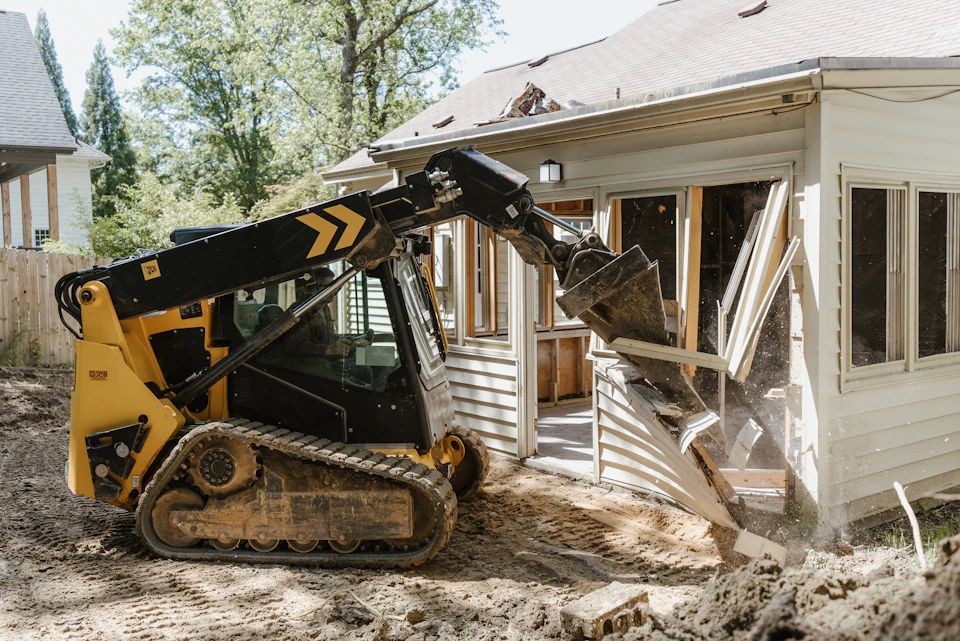
Concrete & Flatwork Removal
Old slabs, patios, walkways, steps, and footings saw-cut, broken out, and carted off across Bergen County — leaving the ground clear for new concrete, a deck, or landscaping.
Concrete & Flatwork Removal
Old concrete does not fall apart on its own. We saw-cut clean edges, break out slabs and footings, and load every piece off site — leaving graded, clear ground ready for new concrete, a deck, a patio, or landscaping. It is part of our demolition services, done on its own or ahead of a larger project.
- Driveway & walkway slab removal
- Patio, porch & step demolition
- Footing & foundation slab breakout
- Saw-cutting for clean partial removals
- Site protection & dust control
- Debris load-out & disposal
Concrete Removal Guides
Cutting, access, disposal, and cost decisions that determine whether flatwork removal goes smoothly.
Scoping the Removal
Concrete removal starts with a clear line between what comes out and what stays. We measure the flatwork, mark the saw-cut lines, and confirm access and disposal before anyone picks up a saw.
- Keep vs remove: the exact slabs, steps, and sections coming out are marked ahead of time so nothing sound gets broken by mistake.
- Cut lines: where a removal stops mid-slab, a saw-cut line is set first so the remaining concrete keeps a clean edge.
- Access & path: how the broken concrete leaves the property — gates, lawn, driveway, dumpster placement — is planned before day one.
- What’s underneath: lines, footings, and reinforcement in or under the slab are located first so the break-out doesn’t hit a surprise.
- Written scope: the removal footprint, grading, and haul-off are put in writing so expectations are agreed before work starts.
Planning a project like this? Get an estimate.
Access & Site Protection
Most of the effort in flatwork removal is getting heavy, broken concrete off the property without tearing up what stays. The route out is protected before the first cut.
- Haul path: lawn, pavers, and finished surfaces along the route to the dumpster are covered and protected before break-out begins.
- Dumpster placement: a container sized for heavy debris is staged where it keeps the carry short and the driveway usable.
- Dust control: saw-cutting and breaking are managed with water or extraction where fine dust would otherwise spread.
- Adjacent structures: foundations, walls, and slabs that stay are protected from over-break and equipment contact.
- Daily cleanup: broken concrete and fines are cleared as work progresses instead of left to pile across the yard.
Planning a project like this? Get an estimate.
Utilities, Rebar & Subgrade
Before a slab is broken, we know what is buried in and under it — both for safety and so the ground below is left in the right shape for what comes next.
- Buried lines: water, gas, electrical, and irrigation running under or beside the flatwork are located before break-out.
- Reinforcement: wire mesh, rebar, and post-tension slabs change the method and equipment; identifying them up front avoids surprises.
- Footings & thickness: thickened edges and footings under a slab are heavier and are planned into the break-out, not discovered mid-job.
- Subgrade: the gravel or soil under the slab is left graded to suit new concrete, a build, or planting.
- Older concrete: where any suspect material is flagged by testing, it is cleared by licensed specialists before removal proceeds; we do not perform abatement.
Planning a project like this? Get an estimate.
Partial vs Full Removal
Not every slab has to come out whole. Sometimes cutting out one failed section is the right call; sometimes the whole thing is easier and cleaner. The decision drives cost and result.
- Partial removal: a cracked, heaved, or sunken section is saw-cut and taken out while the sound concrete around it stays.
- Full removal: a slab that is failing across the board, or one being replaced entirely, comes out in full for a clean base.
- Matching back: where new concrete meets old, a clean cut line makes the tie-in and finish far better than a broken edge.
- Cost trade-off: partial saves material and disposal but adds cutting; we walk the trade-off with you before deciding.
- Permits where required: for projects that require permits, we coordinate permit paperwork, trade documentation, and inspection scheduling with your town and licensed professionals where required.
Planning a project like this? Get an estimate.
Haul-Off & Concrete Recycling
Removal is only finished when the concrete is gone. Haul-off is built into the scope, and clean concrete is a material that recycles well when the facility accepts it.
- Load-out: broken concrete is carried out along protected pathways and staged in a container sized for the weight.
- Recycling: clean concrete is sorted for crushing and reuse where facilities allow rather than sent straight to landfill.
- Licensed disposal: anything not recycled is disposed of through licensed facilities that accept construction debris.
- Honest sorting: what can be diverted depends on the receiving facility; we don’t promise recycling we can’t deliver.
- Clean handoff: the opening is cleared and rough-graded, left ready for the next phase of work.
Planning a project like this? Get an estimate.
What Drives Cost & Timeline
Concrete removal is priced by the work, not a flat rate. Thickness, reinforcement, volume, and access move the number and the schedule more than anything else.
- Thickness & reinforcement: a thin walkway is quick; thick or reinforced slabs and footings take more time and equipment.
- Volume: haul-off and disposal are priced by the amount of concrete, which is heavy and fills weight limits fast.
- Access: backyard slabs, gated sides, and soft ground slow the carry more than square footage suggests.
- Partial vs full: saw-cutting a section adds cutting time; full removal adds volume — the mix sets the schedule.
- Grading: leaving the subgrade ready for new work is planned in rather than left as an extra afterward.
Planning a project like this? Get an estimate.
Your Concrete Removal Process
Walkthrough & scope
We measure the flatwork, confirm what comes out, mark saw-cut lines, check for buried lines and reinforcement, and put the footprint and haul-off in writing.
Protection & access
We protect the lawn and finishes along the haul path, stage a right-sized dumpster, and locate anything running under or beside the slab.
Cut, break & remove
We saw-cut clean edges, break out the concrete, and load it out — reinforced sections handled with the right equipment for the thickness on site.
Haul-off & grade
Debris is disposed of through licensed facilities and clean concrete recycled where possible, and the opening is rough-graded ready for what’s next.
What Concrete Removal Actually Takes
Breaking out flatwork is heavy work that lives or dies on access and disposal. The honest version:
Saw-cutting clean edges
When only part of a slab goes, we saw-cut a straight line first so the concrete that stays keeps a clean, sound edge instead of a ragged break. It is part of our demolition work, planned before anything is broken out.
Thickness, mesh & rebar
A four-inch walkway breaks up fast; a reinforced footing or a slab over wire mesh and rebar is far heavier and slower. What is under the surface drives the effort more than square footage does.
Getting it off the property
Backyard slabs with no driveway access, gated sides, or soft lawn all slow the haul-out. We plan the path and dumpster placement before breaking ground so the debris has a clear route out.
Ready for what’s next
Once the concrete is out and hauled off, we rough-grade the opening so it is ready for new flatwork, a patio or outdoor build, or planting — not left as a rubble-filled hole.
Clearing the Way for What’s Next
Concrete removal is rarely the goal on its own — it clears the way for something better. Knowing what is going back in changes how we take it out: a new slab needs clean subgrade, a deck needs footings clear, a garden needs the base broken up and hauled off.
Reinforced concrete, footings, and thick slabs are heavier and slower than a plain walkway, and access decides the pace as much as thickness. We walk the site and confirm the path off the property before quoting rather than guessing by the square foot.
Removal usually feeds straight into the next phase — new patios or outdoor builds, a whole-home renovation, or fresh flatwork. It is part of our demolition services; request an estimate with the slab size, thickness if known, and any access concerns.
Built Around the Scope
From a single wall to a full gut — matched to what your renovation, repair, or teardown actually needs.
Interior & Selective Demolition
Taking out one wall, a kitchen, or a bath while the rest of the home stays intact and protected. Precise, contained, and swept clean.
Start your estimateFull Gut-Outs & Tear-Outs
Strip a room or an entire level down to studs and subfloor — the clean-slate demo that whole-home renovations and rebuilds start from.
Start your estimateDeck, Shed & Structure Removal
Old decks, sheds, and concrete flatwork removed and hauled away — clearing the site for a new build or an open yard.
Start your estimateKitchen & Bath Tear-Outs
Cabinets, counters, tile, tubs, and fixtures pulled out cleanly with plumbing and gas capped — the room handed off ready for the rebuild.
Start your estimateConcrete & Flatwork Removal
Old slabs, patios, walkways, and footings broken out and carted off — the ground left clear for new concrete, a deck, or landscaping.
Start your estimateDebris Haul-Off & Disposal
Dumpsters staged, material sorted and recycled where possible, and a broom-clean site at the end — no leftover pile for you to deal with.
Start your estimateFrequently Asked Questions
Yes. We saw-cut a clean, straight line where the removal stops so the concrete that stays keeps a sound edge, then break out and haul off only the section you want gone. Partial removals are common when a slab is cracked, heaved, or sinking on one side.
Once the flatwork is broken out and hauled off, we rough-grade the opening so it is ready for new concrete, a deck, a patio, or landscaping. Fresh flatwork and outdoor builds are separate work we can scope at the same time.
Thickness, reinforcement, volume, and access. A four-inch walkway breaks up fast; a reinforced footing or a mesh-and-rebar slab is heavier and slower. A backyard slab with no driveway access takes longer to haul out than a front walkway. We confirm the scope on a walkthrough before quoting.
Yes. Reinforced slabs, footings, and mesh-and-rebar concrete are broken out with the right equipment for the thickness on site. Knowing whether the concrete is reinforced up front helps us plan the method and the schedule.
Where practical. Clean concrete is often accepted for crushing and reuse, so we sort it out for recycling where facilities allow and dispose of the rest through licensed facilities. Recycling depends on what the receiving facility accepts.
Yes. Bergen Restoration is a registered New Jersey Home Improvement Contractor (NJHIC# 13VH08865500) with commercial general liability and workers’ compensation coverage; documentation available on request.
Related Bergen services: Whole-Home Renovation, Basement Renovation, and Water Damage Restoration.
Get Your Estimate
Reach us by phone or email and tell us about your concrete or flatwork removal. We will follow up with the next best step for your home.
Commercial general liability and workers’ compensation coverage. Documentation available on request.
Let's Talk About Your Project
Tell us what you have in mind — we'll follow up with a plan.