
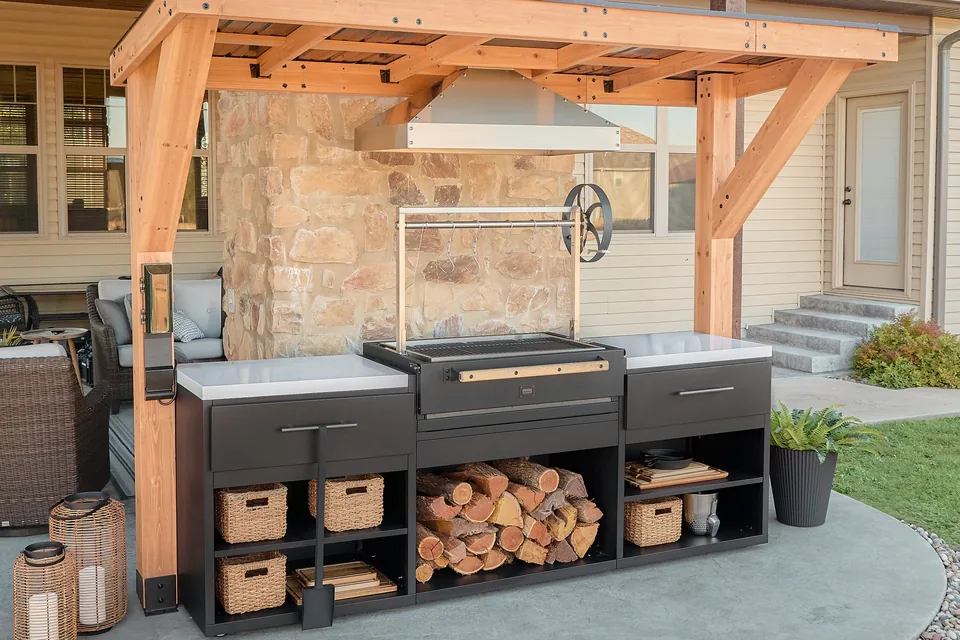
Built-In Grill Installation
Premium built-in and freestanding grills installed with gas line work, GFCI electrical, masonry or cabinet surround, and proper noncombustible clearances.
Built-In & Freestanding Grills
Premium gas grills, built-in grills, smokers, and pizza ovens installed with proper gas line extension, GFCI electrical, masonry or cabinet surround, and manufacturer-required clearances. Coordinated with outdoor kitchens, bars, or grill gazebos where applicable.
- Premium gas grills (natural gas or propane)
- Built-in grill surrounds (masonry or cabinet)
- Smokers, pizza ovens, kamado installs
- Gas line extension and shutoff valves
- GFCI electrical for grill accessories
- Clearance verification to noncombustibles
Built-In Grill Guides
Cabinet, gas-line, and smoke-venting calls that build a real outdoor kitchen.
Cabinet Construction
- Stainless or weather-rated boxes survive outdoors; interior kitchen cabinets outdoors fail.
- Insulated jackets and clearances protect cabinets from grill heat per manufacturer requirements.
- Doors and drawers are detailed for rain and grease — not living-room hardware outdoors.
- Ventilation panels in enclosed bases are a propane-safety requirement, not a style choice.
- Counter support framing carries stone dead-load plus lean-load — engineered, not stacked.
Planning a project like this? Get an estimate.
Gas Line Coordination
- Natural gas or propane is sized to the grill’s BTU draw plus any planned side burners — undersized lines starve the burners.
- Shutoff location, drip leg, and clearances follow code and manufacturer instructions before the island is finished.
- Licensed plumbers and gas trades permit and pressure-test; we do not bury untested fittings behind stone.
- BTU totals add up fast with side burners — the line sizes to the full appliance list, not the grill alone.
- Quick-disconnects make seasonal service painless where codes allow them.
Planning a project like this? Get an estimate.
Hood & Smoke Management
- Open-air installs need only clearances; anything roofed needs the smoke path engineered — up and out, not pooled under a pergola.
- Hood-vented enclosed outdoor kitchens carry hood sizing and duct specs just like an indoor range, rated for grease.
- Prevailing wind and the seating plan decide grill orientation — nobody books the smoke seat twice.
- Island placement off the house wall keeps smoke off siding and out of open windows.
- A dedicated landing zone both sides of the grill is the workflow spec — tongs need parking.
Planning a project like this? Get an estimate.
Counter & Backsplash
- Outdoor-rated stone or stainless surfaces — interior laminates and some quartz fail in UV and freeze-thaw.
- Counter overhangs and backsplash seams sealed against grease and driven rain.
- Porcelain and granite shrug off grease and UV; concrete counters want sealing cycles outdoors.
- Light colors hold less summer heat — a black counter in full sun cooks forearms.
- Seam placement avoids the splash zone — outdoor seams open faster when water sits on them.
Planning a project like this? Get an estimate.
Storage & Tool Drawers
- Sealed drawer storage keeps tools and towels outdoors year-round without rusting into the cabinet.
- Propane lives in ventilated compartments designed for it — never sealed inside cabinetry.
- A dedicated trash-and-recycling pull-out keeps the cook zone clear; the detail that separates outdoor kitchens from grills-on-patios.
- Drawer slides outdoors are stainless or they're temporary — hardware grade decides service life.
- A paper-towel and utensil drawer at the grill ends the kitchen relay.
Planning a project like this? Get an estimate.
Cost & Timeline Guide
- Built-in grill into an existing island $4k–$9k; full island with sink, cold storage, and finish $14k–$35k+.
- Gas stub, electrical for outlets and lights, and stone or steel cladding decide whether this is a drop-in or a small outdoor kitchen.
- Gas permit and inspection are the usual gate; 3–6 weeks including fabrication when the island is custom.
- Utility runs (gas, power) set the budget floor; appliance count sets the ceiling.
- Phased builds work: grill and counter first, refrigeration and bar later on stubbed utilities.
Planning a project like this? Get an estimate.
Your Built-In Grill Process
Consultation
We visit your yard, discuss your goals, measure, and verify feasibility.
Design & selections
We confirm model, materials, and finishes plus any site work required.
Build
Site prep, pad preparation, gas or electrical connection coordination, appliance placement, and commissioning.
Walkthrough
Safety inspection, use walkthrough, and warranty registration.
Built-In Grills Need Utilities & Clearances
A built-in grill is a gas and structure project first. Line size, shutoff access, non-combustible clearances, and island framing decide whether the install is safe and serviceable. Catalog BTU ratings do not replace a field plan for your patio.
We coordinate licensed gas trades for pressure tests and permits where required, and we plan electrical for lights and outlets so the island is not a mess of extension cords. If you want a full outdoor kitchen, step up to that scope rather than forcing every appliance into a single grill bay.
See also outdoor kitchens, grill gazebos, and backyard planning. Request an estimate below with photos of the pad and any existing gas stub.
Frequently Asked Questions
For 2026 in Bergen County, premium gas grills run $1,500-$6,500. Built-in installations with masonry surround, gas line, and GFCI electrical run $5,000-$14,000 depending on surround scope. Pricing and timelines are planning ranges.
Natural gas line work and dedicated electrical circuits typically require permits in Bergen County - where scope and local review apply. Propane with no new electrical usually does not. We confirm with your town.
Natural gas means no tank swaps and lower long-term fuel cost but requires gas line extension from the house. Propane is portable and flexible. We coordinate gas line work with licensed professionals where required.
Yes. We retrofit built-in grills into existing masonry, cabinet surrounds, or pergolas - verifying clearances, ventilation, and gas/electrical capacity before install.
Yes. Bergen Restoration is a registered New Jersey Home Improvement Contractor (NJHIC# 13VH08865500) with commercial general liability and workers' compensation coverage. Documentation is available on request, and homeowners should verify credentials before hiring any contractor.
Masonry or steel-stud construction with cement board — never bare wood framing — insulated jackets where the manufacturer requires, and ventilation cutouts for gas safety. The base outlives several grills.
By total BTU of everything on the run — grill, side burner, future fire pit — with licensed trades running and pressure-testing the line. Undersized lines make big grills cook small.
Quality units slide out of the island for repairs — a design requirement we build in. A grill mortared in place is a future demolition.
Open-air installs vent themselves; roofed or enclosed grill zones need real ventilation planning — clearances, sometimes a rated hood. The structure above decides.
Gas dominates built-ins for convenience; charcoal and kamado units build in beautifully with airflow planned. Hybrid islands hosting both are the entertainer's answer.
Gas off at the shutoff, lines protected, cover rated for the unit, and ceramic units sheltered from freeze-soak cycles. Five minutes each November keeps the island decade-proof.
Part of our Outdoor Living & Backyard, Bergen County NJ service family — explore Carports, Custom Decks, Outdoor Enclosures, Gazebos & Pergolas, Greenhouses, Grill Gazebos, Outdoor Bars, Outdoor Hot Tub & Jacuzzi, Outdoor Kitchens, Outdoor Saunas, Patio Accents, and Swing Sets & Playhouses.
Get Your Estimate
Reach us by phone or email and tell us about your grill installation project. We will follow up with the next best step for your home.
Commercial general liability and workers’ compensation coverage. Documentation available on request.
Let's Talk About Your Project
Tell us what you have in mind — we'll follow up with a plan.